储百亮 2024年9月26日
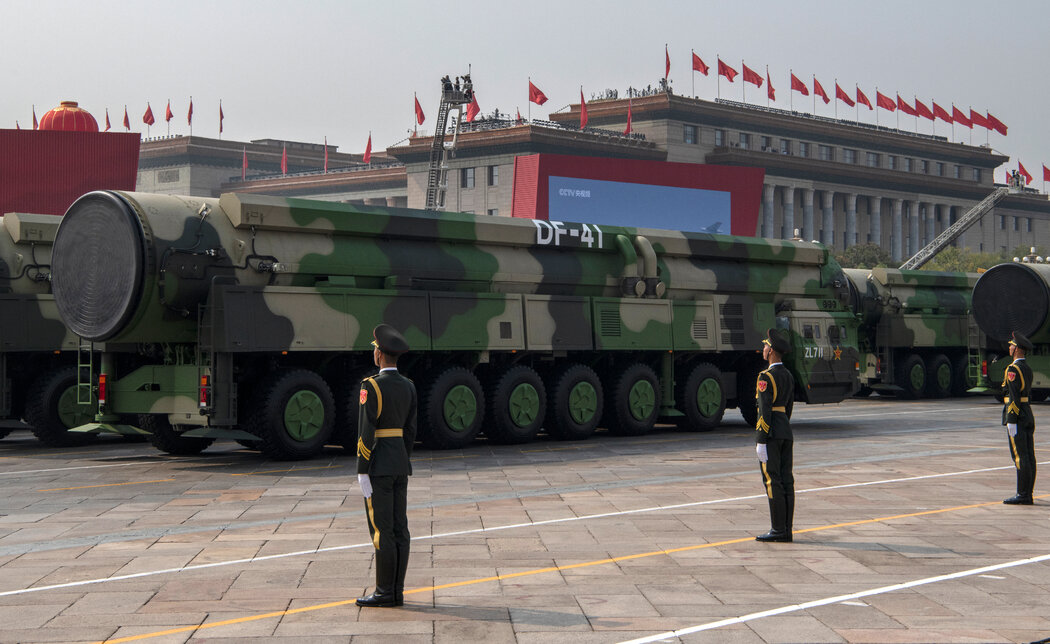
中国军队在天安门广场阅兵式上展示的东风-41洲际弹道导弹,摄于2019年。 Kevin Frayer/Getty Images
China launched an intercontinental ballistic missile carrying a dummy warhead that landed in the Pacific Ocean on Wednesday, the country’s defense ministry announced, in a sign of President Xi Jinping’s commitment to keep strengthening China’s missile force after a period of corruption scandals and command turbulence.
中国国防部宣布,中国在周三向太平洋海域发射了一枚携带模拟弹头的洲际弹道导弹,该导弹已落入太平洋。这表明国家主席习近平决心继续加强中国导弹部队的建设,此前该部队曾经历了一段腐败丑闻和领导层动荡。
The launch appeared to be the first time in 44 years that China has publicly announced a test of an intercontinental ballistic missile in the Pacific region. It was fired by the People’s Liberation Army Rocket Force and struck in the “high seas,” China’s Ministry of National Defense said, without giving details of where the dummy warhead fell, what model of missile carried it or where it was launched. It said the dummy warhead “fell precisely into the assigned seas.”
这似乎是中国44年来首次公开宣布的在太平洋地区进行的洲际弹道导弹测试。中国国防部表示,由解放军火箭军发射的这枚导弹已落入“公海”,但未透露模拟弹头落在了哪里、携带该弹头的导弹型号,以及导弹发射地点等细节。国防部称,模拟弹头“准确落入预定海域”。
“This missile launch was a routine part of the Rocket Force’s annual exercises,” the ministry said, adding that it “was not aimed at any specific country or target.” China’s official news agency, Xinhua, stated that Beijing had notified “the relevant countries” about the missile test, without elaborating. China usually tests its missiles within its own borders.
“此次导弹发射,是年度军事训练例行性安排,”国防部称,并表示它“不针对任何特定国家和目标”。中国官方通讯社新华社称,中国政府已将导弹测试“提前向有关国家作了通报”,但未详细说明是哪些国家。中国通常在本国境内进行导弹试验。
China’s assurances appeared unlikely to dispel questions about the test from experts and officials in the region. Such missiles fly in an arc high above the earth and can deliver warheads thousands of miles, making them a pillar of each superpower’s nuclear capabilities. China has about 134 intercontinental ballistic missiles, or ICBMs, that can deliver around 240 warheads, according to an annual survey from the Federation of American Scientists, a bit under half of the numbers fielded by the United States or Russia.
中国的担保似乎不太可能打消该地区的专家和官员对此次测试的疑问。这种导弹在高空以弧线飞行,可将弹头发射到数千公里外的地方,使其成为每个超级大国核能力的支柱。据美国科学家联合会的年度调查,中国拥有约134枚洲际弹道导弹,能运载约240枚弹头,略低于美国或俄罗斯的一半。
广告
“It is difficult to hide a ballistic missile launch into the Pacific, so it is sensible for Beijing to announce that it took place and control the narrative,” said Drew Thomson, a former Pentagon official who is now a senior fellow at the S. Rajaratnam School of International Studies at Nanyang Technological University in Singapore.
“向太平洋发射弹道导弹很难隐瞒,因此北京宣布进行了发射,并控制叙事的做法是明智的,”五角大楼前官员、现任新加坡南洋理工大学拉惹勒南国际研究学院高级研究员的唐竹安(Drew Thomson)说。
“China is sending a signal,” Mr. Thomson said. “This ballistic missile test puts China’s adversaries on notice that there are limits to its forbearance, and it also underscores the Communist Party’s acute sense of risk and vulnerability.”
“中国正在发出一个信号,”唐竹安说。“这次弹道导弹测试向中国的对手发出警告,中国的宽容是有限度的,导弹测试也凸显了中共对风险和脆弱的敏锐意识。”
Japan, South Korea, Taiwan and other Asian governments are anxious about China’s expanding military strength. “The Japanese government is trying to confirm details,” Yoshimasa Hayashi, the chief cabinet secretary in the Japanese government, said at a regular news conference on Wednesday. He said that Tokyo did not receive advance notice about the launch of the missile, which did not appear to fly over Japanese territory. Japan was already upset about recent incursions into its airspace by Chinese and Russian military aircraft.
日本、韩国、台湾,以及其他亚洲国家的政府对中国不断扩大的军事实力感到焦虑。“日本政府正在试图确认细节,”日本政府内阁官房长官林芳正周三在例行记者会上说。他表示,东京没有收到有关导弹发射的事先通知,导弹似乎没有从日本领土上飞过。日本已对中国和俄罗斯的军机最近侵入其领空感到不安。
“China’s military activities lack transparency, and that has become a serious concern for Japan and the international community,” Mr. Hayashi said.
“中国的军事活动缺乏透明度,这已成为日本和国际社会的严重关切,”林芳正说。
The Pentagon calls China the “pacing challenge” to the United States’ global military dominance, especially in Asia. The Rocket Force is the custodian of most of China’s nuclear weapons as well as many hundreds of conventionally armed missiles. It has been at the forefront of the ambitions of China’s top leader, Xi Jinping, to project power across the region and blunt American influence.
五角大楼称中国对美国在全球的军事主导地位构成“长远的挑战”,尤其是在亚洲。火箭军负责保管中国的大部分核武器和数百枚常规导弹。它一直处于中国最高领导人习近平要向亚太地区投射实力、削弱美国影响的雄心的最前列。
But over the past two years, China’s weapons bureaucracy appeared unsettled by scandal. In 2023, Mr. Xi abruptly replaced the two top commanders of the Rocket Force with outsiders with no experience in the missile force. Other senior officers also disappeared, as did two former Chinese ministers of defense.
但在过去两年里,中国的武器装备部门似乎遭受了丑闻的动荡。2023年,习近平突然用没有导弹部队经验的外来者换下了火箭军的两名高级指挥官。其他高级军官也消失了,同样的事情还发生在两名中国前国防部长身上。
广告
China may have at least partly intended the launch to reinforce the credibility of its missile forces, and its nuclear deterrent, said Ying-Yu Lin, an assistant professor at Tamkang University in Taiwan who specializes in the People’s Liberation Army. “They would like to dispel doubts abroad about the strength of the Rocket Force,” he said.
中国也许想通过这次发射来至少部分地展示其导弹部队和核威慑的可信度,台湾淡江大学专门研究人民解放军的助理教授林颖佑说。“他们希望能消除国外对火箭军实力的怀疑,”他说。
In June, the Chinese Communist Party leadership expelled the two ministers — Li Shangfu and Wei Fenghe — from the party, accusing them of corruption and disloyalty. The following month, party leaders confirmed the expulsions of Li Yuchao, a former Rocket Force commander, and Sun Jinming, a former chief of staff.
今年6月,中共领导层开除了两任国防部长李尚福和魏凤和的党籍军籍,指责他们腐败和对党不忠诚。次月,中共领导人证实,火箭军前司令员李玉超和前总参谋长孙金明也被开除党籍。
Even so, the Chinese rollout of new missiles does not seem to have slowed much. The Pentagon’s latest report on the People’s Liberation Army said last year it was developing new intercontinental missiles “that will significantly improve its nuclear-capable missile forces.” The report also said that China “may be exploring” development of conventionally-armed intercontinental ballistic systems.
尽管如此,中国推出新型导弹的速度似乎并没有放慢多少。去年五角大楼关于中国人民解放军的最新报告称,中国军方一直在研发“将大大增强其核导弹力量”的新型洲际导弹。五角大楼的报告还说,中国“也许正在探索”研发运载常规武器的洲际弹道系统。
China last announced an intercontinental ballistic missile test into the Pacific Ocean in May 1980, according to Chinese news reports about the latest launch. In 2021, China launched two tests of hypersonic gliders than can be carried into orbit by missiles, potentially with nuclear warheads. The People’s Liberation Army has also built over 300 silos that could house intercontinental ballistic missiles across three sites in northern China.
据中国新闻媒体报道,中国上次宣布在太平洋进行洲际弹道导弹测试是1980年5月。2021年,中国进行了两次高超音滑翔飞行器测试,它们是通过导弹送入轨道,可能有携带核弹头的能力。中国人民解放军还在中国北方的三个地方建设了300多个可容纳洲际弹道导弹的发射井。