**High spending, low taxes—and don’t worry about the deficit **
高支出、低税收——而且不用担心赤字
Photograph: Getty Images 照片:Getty Images
Sep 30th 2024|Washington, DC 2024 年 9 月 30 日华盛顿特区
GO TO ANY American high school holding an election for class president and inevitably one candidate will craft an agenda of alluring promises—free pizza at lunch, limitless recess after—well beyond their capacity to actually turn them into reality. The same impulse animates the latest economic-policy speeches delivered by Kamala Harris and Donald Trump in battleground states. Their competing visions offer utopia without trade-offs—economics without the economising—in which spending is higher, taxes are lower, deficits are unimportant, inflation is licked, jobs are protected and growth is high.
对于任何举行班长选举的美国高中,不可避免地会有一位候选人制定一个诱人的承诺议程——午餐时提供免费披萨,之后无限次休息——远远超出了他们真正将它们变为现实的能力。卡马拉·哈里斯(Kamala Harris)和唐纳德·特朗普(Donald Trump)在战场州发表的最新经济政策演讲也激发了同样的冲动。他们相互竞争的愿景提供了没有权衡的乌托邦——没有经济的经济学——在这种乌托邦中,支出更高,税收更低,赤字不重要,通货膨胀被舔舐,就业得到保护,增长高。
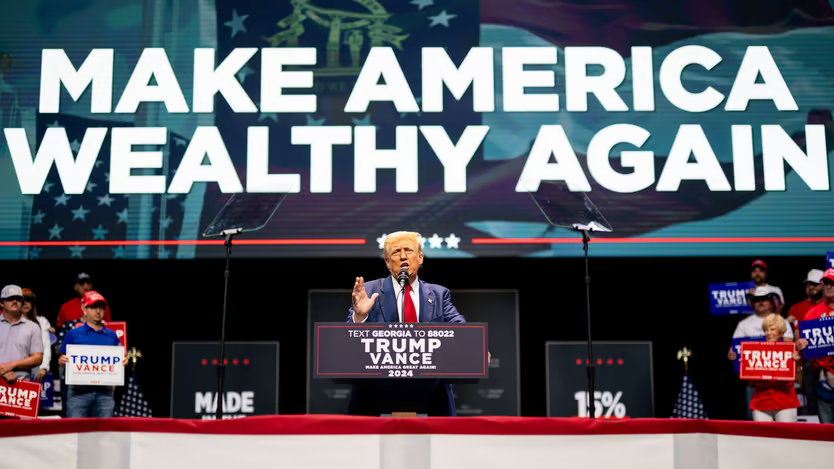
Speaking in Pittsburgh, Pennsylvania, on September 25th, Ms Harris branded herself a pragmatic capitalist who would double down on Bidenomics by expanding state subsidies for housing, child care and domestic manufacturing. In Savannah, Georgia, the day before, Mr Trump pitched his own “manufacturing renaissance” in which America would “take other countries’ jobs” through preferential tax rates, deregulation and punitive tariffs (including a new threat of a 100% duty on cars made in Mexico). Then in a stemwinder delivered in the town of Walker, Michigan, on September 27th, Mr Trump warned that the American auto industry would cease to exist unless he were elected*.*
9 月 25 日,哈里斯女士在宾夕法尼亚州匹兹堡发表演讲时,将自己标榜为务实的资本家,她将通过扩大对住房、儿童保育和国内制造业的州补贴来加倍支持 Bidenomics。前一天,特朗普在佐治亚州萨凡纳(Savannah)推销了他自己的“制造业复兴”,美国将通过优惠税率、放松管制和惩罚性关税(包括对墨西哥制造的汽车征收100%关税的新威胁)来“抢走其他国家的工作”。然后,9月27日,在密歇根州沃克镇(Walker, Michigan)的一次收卷机上,特朗普警告说,除非他当选,否则美国汽车工业将不复存在。
Trumponomics has shattered the Reaganomic orthodoxy that guided Republican thinking for decades. Mr Trump has broken the party out of its free-trading ways, (at least notional) concern for the national debt and scepticism towards family subsidies and entitlement programmes. Droves of working-class Americans have become Republicans, prompting the party to adopt warmer attitudes towards unions, tax credits and low-wage workers—all of which were once chiefly Democratic concerns.
特朗普经济学已经粉碎了几十年来指导共和党思想的里根经济学正统观念。特朗普已经打破了该党的自由贸易方式,(至少在名义上)对国债的担忧,以及对家庭补贴和福利计划的怀疑。大批美国工人阶级已经成为共和党人,促使该党对工会、税收抵免和低薪工人采取更温和的态度——所有这些都曾经是民主党的主要关注点。
The new version of Trumponomics consists of enormous tariffs; even lower corporate taxes (the rate he has in mind is 15%); a bevy of individual tax cuts plus new exemptions by not taxing wages on tips and Social Security benefits. He now wants to remove ten regulations for every new one implemented (during his first four years in office, he pledged to rescind a mere two regulations for each one implemented, though the Brookings Institution, a think-tank, reckons he failed to live up to that). In addition to unlucky Mexico, Mr Trump has proposed a 60% duty on goods imported from China and a 20% broad-based tariff on goods imported from other countries. In total, the Tax Foundation, a non-partisan budget scorer, estimates that Mr Trump’s plans would cost $1.3trn over the coming decade, while other analysts reckon they could end up costing closer to $4trn depending on how the ensuing trade war escalated. In either case, it would wipe out the economic gains from the tax cuts.
新版特朗普经济学包括巨额关税;更低的公司税(他心目中的税率是 15%);一系列个人减税加上新的豁免,不对小费和社会保障福利的工资征税。现在,他希望每实施一项新法规就取消十项法规(在他上任的头四年里,他承诺每实施一项法规就取消两项法规,尽管智库布鲁金斯学会(Brookings Institution)认为他没有兑现这一承诺)。除了不幸的墨西哥之外,特朗普还提议对从中国进口的商品征收 60% 的关税,并对从其他国家进口的商品征收 20% 的广泛关税。总的来说,无党派预算评分者税务基金会估计,特朗普先生的计划在未来十年将花费 1.3 万亿美元,而其他分析师则认为,根据随后的贸易战如何升级,他们最终可能会花费接近 4 万亿美元。无论哪种情况,它都会抹去减税带来的经济收益。
Bidenomics was itself developed as a reaction to Trumponomics. It co-opted its urge to protect prized industries, but married that to the Bernie Sanders- or Elizabeth Warren-style agenda that aspired to a Green New Deal, Medicare for All and no student debt, all funded by large taxes on the wealthy. Throughout these sweeping changes to economic thinking, Ms Harris has been passive. In 2019 she embraced the ideas of the progressive left and then backtracked as the political winds shifted. In her recent campaign speeches—and a newly released 82-page policy document that aims to describe Kamalanomics—she has not sought to break new ground.
Bidenomics 本身就是作为对 Trumponomics 的反应而开发的。它利用了保护珍贵行业的冲动,但将其与伯尼·桑德斯(Bernie Sanders)或伊丽莎白·沃伦(Elizabeth Warren)式的议程相结合,该议程渴望绿色新政、全民医保和无学生债务,所有这些都由对富人征收巨额税提供资金。在经济思维的这些彻底变化中,哈里斯一直保持被动。2019 年,她接受了进步左翼的思想,然后随着政治风向的变化而退缩。在她最近的竞选演讲中——以及新发布的一份旨在描述 Kamalanomics 的 82 页政策文件——她并没有寻求开辟新天地。
Having resisted filling in policy details, Ms Harris has begun to elaborate on what she means when she promises an “opportunity economy” and “a new way forward”. Like Mr Biden, she wishes to “finish the job” on Build Back Better, the grand plan for reorganising the American economy, by passing the tax increases—on corporate income, the capital gains of the wealthy (including, for the first time, unrealised ones)—that he could not. This would in theory be used to pay for generous, permanent expansions of the annual child tax credit, which would be as high as $6,000 for newborns, and to provide cheaper care for children and the elderly while care workers would receive larger paycheques (how exactly is left as an exercise for the reader).
在拒绝填写政策细节后,哈里斯女士已经开始详细说明她承诺“机会经济”和“新的前进道路”的含义。和拜登一样,她希望通过对企业收入、富人的资本收益(包括首次未实现的资本收益)的增税——来“完成重建更好”(Build Back Better)的“工作”,这是重组美国经济的宏伟计划。理论上,这将用于支付年度儿童税收抵免的慷慨、永久扩展,新生儿将高达 6,000 美元,并为儿童和老人提供更便宜的护理,而护理人员将获得更高的薪水(具体如何留给读者练习)。
There would be new tax credits, too: a new promise of $25,000 in downpayment assistance for first-time homebuyers, an expanded credit of $50,000 to startup founders, and a new “America Forward” tax credit that seems to be a catch-all for expanded industrial policies for, among other things, clean steel, biotechnology, data centres needed for AI, and semiconductors. There are also gestures towards the supply-side reforms that would be needed to ensure these expenditures do not just drive up costs—such as expediting permitting and removing zoning laws that are barriers to homebuilding. Ms Harris is pitching the state as the saviour of the people against the depravations of the wealthy and of large corporations.
还将有新的税收抵免:为首次购房者提供 25,000 澳元的首付援助的新承诺,向初创公司创始人提供 50,000 澳元的扩大信贷,以及新的“America Forward”税收抵免,这似乎是扩大产业政策的包罗万象,其中包括清洁钢铁、生物技术、人工智能所需的数据中心和半导体。还有一些对供给侧改革的姿态,以确保这些支出不仅推高成本,例如加快许可和取消阻碍住房建设的分区法律。哈里斯女士将国家宣传为人民的救世主,反对富人和大公司的堕落。
In a sign of how both parties have morphed, she repeatedly criticises Trumponomics for being too meek. Ms Harris has taken to attacking the USMCA, the trade deal negotiated under Mr Trump that superseded NAFTA, for not doing enough to protect American workers. She argues that Mr Trump was too soft on China, by ceding production of semiconductors and “cars of the future”. And she castigates Mr Trump as “one of the biggest losers of American manufacturing in our history” because net manufacturing jobs declined by 200,000 over his term. This is a bit of statistical slipperiness—under Mr Trump, manufacturing jobs increased from 12.4m to 12.8m before collapsing during the covid-19 pandemic. Ms Harris also quickly copied Mr Trump’s promise to not tax tipped wages. And although she criticises Mr Trump’s proposed new tariffs as a new national sales tax on the American people, she would keep the tariffs that Mr Trump imposed on China.
作为两党转变的一个迹象,她一再批评特朗普经济学过于温顺。哈里斯开始攻击《美墨加协定》(USMCA),即特朗普在特朗普领导下谈判达成的取代北美自由贸易协定(NAFTA)的贸易协定,称其在保护美国工人方面做得不够。她认为,特朗普对中国过于软弱,放弃了半导体和“未来汽车”的生产。她还严厉谴责特朗普是“美国制造业历史上最大的输家之一”,因为在他的任期内,制造业净就业岗位减少了20万个。这在统计上有点滑稽——在特朗普先生的领导下,制造业工作岗位从 12.4m 增加到 12.8m,然后在 covid-19 大流行期间崩溃。哈里斯还迅速复制了特朗普的承诺,不对小费工资征税。尽管她批评特朗普提议的新关税是对美国人民征收的新全国销售税,但她仍将保留特朗普对中国征收的关税。
Nonetheless, Mr Trump and Ms Harris do offer distinct visions for the economy. Although both present themselves as champions of manufacturing, their strategies differ. Whereas Mr Trump wants to slap tariffs on all imports, Ms Harris hopes to finetune subsidies for green technologies. Whereas Mr Trump believes that sweeping tax cuts will rev up the economy, Ms Harris wants higher taxes on the rich and more handouts for the poor to reduce inequality. And whereas Mr Trump dreams of slashing regulations, Ms Harris thinks the state should steer growth in the desired direction. Yet there is one thread that runs through both of their plans: they see no need to weigh the costs of their proposals when the benefits are, to their minds, so vast and obvious. ■
尽管如此,特朗普和哈里斯确实为经济提供了截然不同的愿景。尽管两者都将自己标榜为制造业的拥护者,但他们的策略不同。特朗普希望对所有进口商品征收关税,而哈里斯则希望微调对绿色技术的补贴。特朗普认为全面减税会提振经济,而哈里斯则希望提高富人的税收,为穷人提供更多的救济,以减少不平等。虽然特朗普梦想削减监管,但哈里斯认为该州应该将增长引向理想的方向。然而,有一条主线贯穿于他们的两个计划中:他们认为没有必要权衡提案的成本,因为在他们看来,收益是如此巨大和明显。 ■