Netanyahu Vows Retaliation, Calls for Unity Government
内塔尼亚胡誓言报复,呼吁成立团结政府
By Lisa Beyer 2023年10月9日 Updated on 2023年10月11日
The notion that Israelis and Palestinians can share the Holy Land living in separate, independent nations fueled on-and-off peace talks for more than 20 years. But the latest round foundered in 2014. In recent years, Israel has focused on making peace with Arab states, leaving the Palestinians with limited self-rule under the ultimate control of Israel. The Palestinian-Israeli violence that broke out in October challenged the idea that the status quo was sustainable, reviving calls by some countries for diplomacy aimed at the two-state solution. That option, however, is hardly popular on either side.
以色列人和巴勒斯坦人可以在各自独立的国家中共享圣地,这一理念推动了长达 20 多年的断断续续的和平谈判。但最近一轮谈判于 2014 年宣告失败。近年来,以色列专注于与阿拉伯国家实现和平,让巴勒斯坦人在以色列的最终控制下实现有限的自治。今年10月爆发的巴以暴力冲突对这种现状的可持续性提出了挑战,一些国家再次呼吁开展旨在实现两国解决方案的外交活动。然而,这一方案在双方都不受欢迎。
1. What’s the history of the two-state solution?
1.两国解决方案的历史是怎样的?
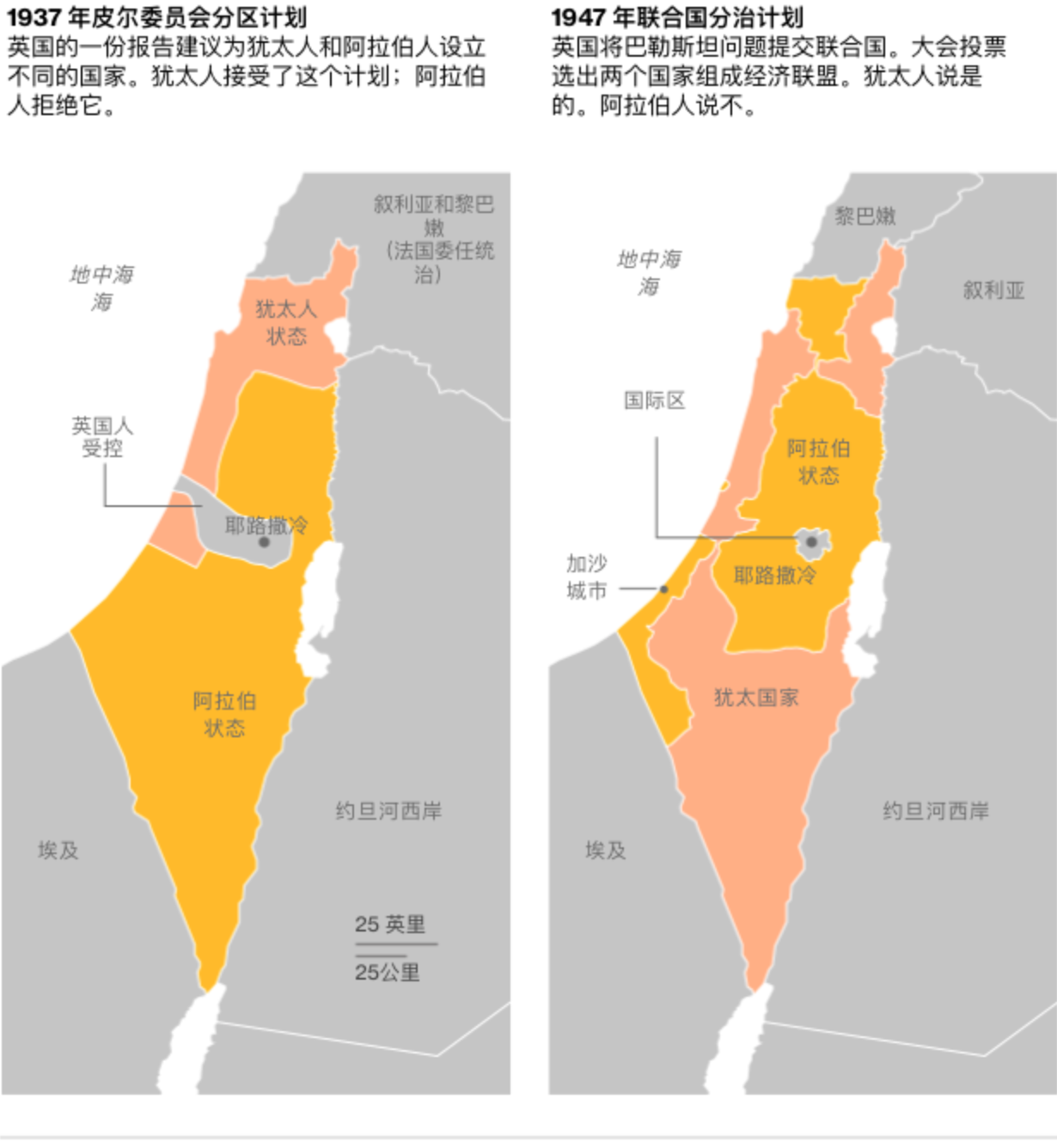
Part of the Ottoman Empire from 1517, the Holy Land came under British governance when World War I victors divided control over the losers’ territory. The two-state solution dates to the 1937 Peel Commission, which recommended partitioning what was then called British Mandatory Palestine to stop Arab-Jewish violence. The United Nations embraced a different partition plan in 1947, but the Arabs rejected both, leading to Israel’s declaration of independence in 1948 and the first Arab-Israeli war. That period produced more than half a million Palestinian refugees. In a 1967 war, Israel captured, among other Arab territories, the Gaza Strip, the West Bank and East Jerusalem, putting residents under military occupation and fanning Palestinian nationalism. After a Palestinian uprising that began in 1987 claimed more than 1,200 Palestinian and 200 Israeli lives, secret negotiations produced the landmark 1993 Oslo accords. As an interim measure, Palestinians gained limited self-rule under an entity called the Palestinian Authority.
自 1517 年以来,圣地一直是奥斯曼帝国的一部分,第一次世界大战的胜利者对战败者的领土进行了分割,圣地也随之归英国管理。两国解决方案可追溯到 1937 年的皮尔委员会,该委员会建议对当时被称为英国托管的巴勒斯坦进行分治,以阻止阿拉伯人和犹太人之间的暴力。联合国在 1947 年采纳了另一个分治方案,但阿拉伯人拒绝了这两个方案,导致以色列在 1948 年宣布独立,并爆发了第一次阿以战争。这一时期产生了 50 多万巴勒斯坦难民。在 1967 年的战争中,以色列占领了加沙地带、约旦河西岸和东耶路撒冷等阿拉伯领土,将居民置于军事占领之下,并煽动了巴勒斯坦民族主义。1987 年开始的巴勒斯坦起义夺走了 1200 多名巴勒斯坦人和 200 多名以色列人的生命,此后,秘密谈判达成了具有里程碑意义的 1993 年奥斯陆协议。作为一项临时措施,巴勒斯坦人在一个名为巴勒斯坦权力机构的实体下获得了有限的自治权。
How Two Peoples Could Have, and Have Split the HolyLand
两个民族如何分裂圣地
Sources: The Routledge Atlas of the Arab-Israeli Conflict; CIA; United Nations
资料来源Routledge 阿以冲突地图集》、中央情报局、联合国

2. Why did the Oslo accords fall short?
2.奥斯陆协定》为何失败?
The military occupation, Israeli settlement building and violence continued, as the two sides repeatedly failed to resolve issues standing in the way of a promised final agreement that presumably would have established a Palestinian state. A second Palestinian uprising, from 2000 to 2005, was especially bloody. Most countries already recognize Palestine as a state, but that hasn’t changed things on the ground: Israel has ultimate control over the territory. Stumbling blocks in Israeli-Palestinian negotiations included where to draw borders, how to share Jerusalem, and the status of Palestinian refugees. Israel acted alone in 2005, withdrawing its troops and settlers from the Gaza Strip, while largely sealing the frontier and later imposing a blockade after the militant group Hamas wrested control of the territory from the Palestinian Authority in 2007. Gaza subsequently became a launchpad for rockets, mortars and Palestinian fighters into Israel.
军事占领、以色列定居点建设和暴力活动仍在继续,因为双方一再未能解决阻碍达成承诺的最终协议的问题,而最终协议本可以建立一个巴勒斯坦国。2000 年至 2005 年的第二次巴勒斯坦起义尤为血腥。大多数国家已经承认巴勒斯坦是一个国家,但这并没有改变当地的局势:以色列对这片领土拥有最终控制权。以巴谈判的绊脚石包括如何划定边界、如何分享耶路撒冷以及巴勒斯坦难民的地位。2005 年,以色列单独行动,从加沙地带撤出了军队和定居者,同时在很大程度上封锁了边界,后来又在激进组织哈马斯于 2007 年从巴勒斯坦权力机构手中夺回该领土的控制权后实施了封锁。加沙随后成为向以色列发射火箭弹、迫击炮弹和巴勒斯坦战斗人员的基地。
3. What do Israelis and Palestinians think of a two-state solution?
3.以色列人和巴勒斯坦人如何看待两国解决方案?
A joint survey of Israelis and Palestinians conducted in December 2022 found that support for a two-state solution had fallen to [the lowest level](https://www.pcpsr.org/sites/default/files/Summary Report_ English_Joint Poll 24 Jan 2023.pdf) since 2016. According to the survey, the idea was supported by 33% of Palestinians and 34% of Israeli Jews.
2022 年 12 月对以色列人和巴勒斯坦人进行的一项联合调查发现,对两国解决方案的支持率已降至 2016 年以来的最低水平。调查显示,33%的巴勒斯坦人和34%的以色列犹太人支持这一想法。
4. What are the alternatives?
4.有哪些替代方案?
Many Israelis support the idea of extending Israeli sovereignty to at least part of the West Bank, where Israeli settlement-building has continued. Supporters of annexation say Israelis have a right to remain permanently in the West Bank, which they call by its biblical name of Judea and Samaria — the cradle of Jewish civilization. If Israel ultimately took full control over more Palestinians in the West Bank, it would have to choose between offering them citizenship — thereby diluting the country’s Jewish majority — or keeping them stateless, reinforcing accusations of apartheid. In the December poll, 37% of Israeli Jews said they’d like to see a solution involving a single non-democratic state in which Palestinians didn’t have equal rights. Thirty percent of Palestinians said they wanted a single, Palestinian-dominated state. Smaller minorities on both sides supported a binational state with equal rights for everyone.
许多以色列人支持将以色列主权至少扩展到西岸部分地区的想法,以色列在那里的定居点建设仍在继续。支持吞并的人说,以色列人有权永久留在西岸,他们称西岸为圣经中的朱迪亚和撒马利亚--犹太文明的摇篮。如果以色列最终完全控制了约旦河西岸更多的巴勒斯坦人,它将不得不在向他们提供公民身份--从而稀释该国犹太人的多数--或保持他们的无国籍状态--从而加强对种族隔离的指责之间做出选择。在 12 月的民意调查中,37% 的以色列犹太人表示,他们希望看到一种解决方案,即建立一个巴勒斯坦人没有平等权利的单一非民主国家。30%的巴勒斯坦人表示,他们希望建立一个由巴勒斯坦人主导的单一国家。双方都有少数人支持建立一个人人享有平等权利的两国国家。