Geopolitical tensions on Earth threaten to drive Cold War-style division in space.
地球上的地缘政治紧张局势可能会推动太空中的冷战式分裂。

5月,中国火箭载着天宫空间站的三名宇航员替补组员升空。图片来源:KEVIN FRAYER/GETTY IMAGES
Natasha Khan2023年9月4日16:05 CST 更新
A new Cold War-style competition has put the moon back at the center of global space ambitions, but the U.S. has a new chief rival.
一场新的冷战式竞争让月球重新成为展示全球太空雄心的中心舞台,不过,美国有了一个新的主要对手。
More nations and companies are venturing into space, crowding the calendar with planned robotic landings for lunar research. But, like the scramble to plant boots on the moon in the 1960s, the race to establish a base on the lunar surface boils down to a contest between the world’s superpowers. Only this time it is Beijing, not Moscow, that Washington is up against.
越来越多的国家和公司开始涉足太空,计划进行的机器人登月研究排满了日程表。不过,就像20世纪60年代争相登月一样,在月球表面建立基地的竞赛归根结底是世界超级大国之间的较量。只不过这次美国的对手不是俄罗斯,而是中国。
China has been aggressively ramping up its space program since the U.S. barred it from working with the National Aeronautics and Space Administration in 2011 on security grounds. After a string of triumphs in recent years, it set its sights on starting to build a permanent moon base around the end of the decade—reviving U.S. lunar ambitions, with echoes of America’s all-out effort to beat the Soviet Union to the moon.
自2011年美国以安全为由禁止中国与美国国家航空航天局(National Aeronautics and Space Administration, 简称NASA)合作以来,中国一直在积极推进自己的太空计划。近几年取得一系列巨大成功后,中国将目光投向了在2030年前后开始建设永久性月球基地,寻求复制美国的探月雄心,并让人想起美国当年全力以赴寻求在登月竞赛中击败苏联的情景。

1969年7月,人类登上月球。阿波罗11号宇航员阿姆斯特朗在月球着陆器旁,他的头盔面罩上映出了同行宇航员奥尔德林的身影。图片来源:AP, NEIL ARMSTRONG/NASA/AP
Only American astronauts have stepped on the moon’s surface—and for decades there had been little interest in repeating the feat. Exploration efforts instead focused on robotic missions into deeper space.
迄今只有美国宇航员踏上过月球表面,几十年来全球对于再现这一壮举兴趣索然。太空探索的重点转而放在利用机器人探索更遥远的太空。
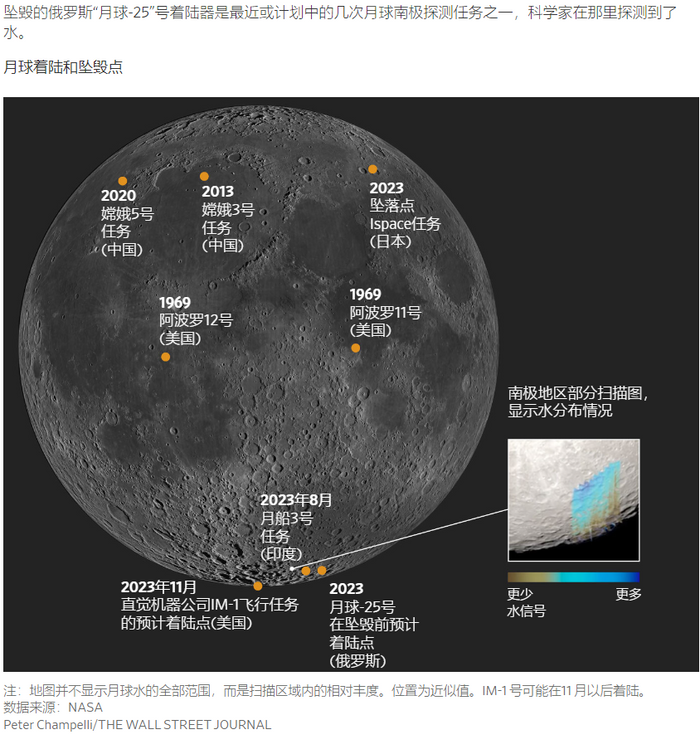
Two years ago, China said it would join Russia in building a moon base and invited other interested nations to take part. But decades after the Soviet Union beat the world into space, Russia is a waning space power. Last month, a Russian lander crashed on the country’s first mission to the moon since Luna-24 in 1976, another setback for Moscow’s effort to again become a force in space exploration.
两年前,中国表示将与俄罗斯一起建设月球基地,并邀请其他感兴趣的国家参与。不过,几十年前苏联率先将宇航员送入太空后,如今俄罗斯的太空实力正减弱。上个月,在俄罗斯自1976年“月球-24”号以来的首次登月任务中,一个探测器坠毁,俄罗斯重新成为一支太空探索力量的努力再次受挫。
Yury Borisov, the director general of Russia’s space agency, Roscosmos, said “the invaluable experience that our predecessors gained in the 1960s-1970s was almost lost” because of a disconnect between generations, according to state news agency TASS. After the moon crash, Kremlin spokesman Dmitry Peskov told reporters that Russia would persevere in its lunar program, TASS said.
据国家通讯社塔斯社(TASS)报道,俄罗斯航天局局长鲍里索夫(Yury Borisov)表示,由于代际传承中断,“我们的前辈在20世纪60-70年代积累的宝贵登月经验几乎丢失殆尽”。塔斯社称,月球探测器坠毁事件发生后,克里姆林宫发言人佩斯科夫(Dmitry Peskov)告诉记者,俄罗斯将坚持其登月计划。
While Russia remains dependable at launching satellite payloads and ferrying crew and cargo to the International Space Station, around 250 miles from Earth, and while it has more than two decades’ experience helping to run the ISS, its failures in more-challenging space exploration mean China is at mission control in the partnership.
虽然俄罗斯在发射卫星有效载荷、向距地球约250英里的国际空间站(International Space Station)运送乘员和货物方面仍然值得信赖,而且俄罗斯在帮助运行国际空间站方面拥有二十多年的经验,但该国在更具挑战性的太空探索领域遇挫意味着,在相关的合作伙伴关系中,中国是任务掌控者。
Russia’s invasion of Ukraine and the ensuing sanctions have further strained Russian space plans. Doubts about its moon missions, swelling before the invasion, have grown faster with the imposition of technology controls and restrictions aimed at Russia’s aerospace and space sectors.
俄罗斯入侵乌克兰以及随之而来的制裁给俄罗斯的太空计划造成进一步压力。在入侵乌克兰之前,俄罗斯的登月计划就已经饱受质疑,随着针对俄罗斯航空航天领域的技术控制和限制措施的实施,质疑声更甚。
China’s technological achievements in space have outstripped Russia’s. For example, it landed a rover on Mars on its first try in 2021. The Soviets landed a rover in 1971 after earlier failures, but it broke down almost immediately.
中国在太空领域取得的技术成就已然超过俄罗斯。例如,2021年,中国首次尝试就成功实现了一辆漫游车在火星表面的着陆。苏联在经历几次失败后于1971年在火星表面着陆了一枚探测器,但几乎立刻就出现了故障。

8月11日,联盟号火箭携带月球着陆器“月球-25”号起飞,这是俄罗斯自1976年以来的首次登月任务,但最终在月球表面坠毁。图片来源:ROSCOSMOS STATE SPACE CORP./ASSOCIATED PRESS
In this latest moon race, Washington and Beijing are recruiting allies.
在这场最新的探月竞赛中,美国和中国正在招募盟友。
The U.S. has been leading the Artemis Accords. Devised by the Trump administration as China laid out increasingly ambitious lunar plans, these bind the U.S. and 27 other countries in a collaboration that lays out a framework for the peaceful exploration of the moon, Mars and other celestial bodies. The Artemis program aims for humans to return to the moon by 2025, and to establish a sustained presence there.
美国主导了《阿尔忒弥斯协定》(Artemis Accords)。这项协定是特朗普(Donald Trump)政府在中国提出日益宏伟的登月计划时设计,联合了美国和其他27个国家的力量,为和平探索月球、火星和其他天体确定了一个合作框架。阿尔忒弥斯计划的目标是实现人类最迟在2025年重返月球,并在那里建立一个持续的存在。
Chinese critics bristled at the framework, calling it a U.S. attempt to stymie China and set rules that favor its own interests. In one 2020 article, the Global Times, a Communist Party mouthpiece, criticized Washington’s “Cold War mentality against space rivals.”
这一框架令中国的批评人士感到不悦,他们称美国此举是为了遏制中国并制定有利于自身利益的规则。在2020年的一篇文章中,中共喉舌《环球时报》批评美国政府以冷战思维对付太空领域的竞争对手。
The accords and the U.S. alliance they foster are a hurdle for Beijing, given the prohibition against working with NASA as well as Washington’s more recent efforts to deny China access to cutting-edge technologies.
鉴于禁止NASA与中国合作的规定以及美国最近阻止中国获得尖端技术的种种举措,这些协议及其构建的美国联盟对中国的太空探索是一道阻碍。

2021年5月,中国的太空计划实现了巨大的飞跃,首次尝试在火星上着陆了一辆漫游车。图片来源:CNSA/AP, REUTERS, ZUMA, AFP
“Space relations between the two global powers have gotten more frosty,” said Namrata Goswami, a co-author of the book “Scramble for the Skies: The Great Power Competition to Control the Resources of Outer Space.” She noted that the Biden administration has been tightening controls on exports of semiconductors and sensitive satellite technologies to China.
“这两个全球大国在太空领域的关系已经变得更加冷淡,”《抢占太空:外层空间资源的大国竞争》(Scramble for the Skies: The Great Power Competition to Control the Resources of Outer Space)一书的合著者Namrata Goswami说。她指出,拜登政府已经在加强对向中国出口半导体和敏感卫星技术的控制。
China has forged ahead on its own. Barred by that 2011 law from sending its astronauts to the ISS—which has hosted more than 200 astronauts from more than a dozen countries—the country built its own space station.
中国已凭借自身的力量推进了太空计划。美国上述2011年的法律禁止中国宇航员进入国际空间站,但中国建造了自己的空间站。已有超过十二个国家的200多名宇航员进入过国际空间站。
Still, as more nations invest in their own programs, there is symbolism in working together. India sparked an outpouring of national pride last month by becoming the fourth nation to achieve a controlled landing on the moon, and the first to do so in the south polar region. Hours before the landing, Prime Minister Narendra Modi—who had signed the U.S. accords on a state visit to Washington in June—used a summit under the Brics grouping, which includes China and Russia, to float the idea of a Brics Space Exploration Consortium.
不过,随着越来越多的国家投资于本国的项目,合作也有了一定的象征意义。上个月,印度成为第四个实现受控登月的国家,也是首个在月球南极地区实现受控登月的国家,引发了强烈的民族自豪感。在登月前几个小时,印度总理莫迪(Narendra Modi)利用包括中国和俄罗斯在内的金砖国家(BRICS)的一次峰会,提出了建立金砖国家太空探索联盟(Brics Space Exploration Consortium)的想法。莫迪6月份对华盛顿进行国事访问时与美国签署了相关协议。
“It will be very difficult for nations to keep a foot in both camps,” said Christopher Newman, a professor of space law and policy at the U.K.’s Northumbria University. While there may still be some pockets of European collaboration with China, Newman said, it is difficult to envision large-scale projects unless U.S.-China relations improve significantly.
英国诺桑比亚大学(Northumbria University)太空法律与政策教授Christopher Newman表示:“各国很难脚踏两个阵营。”Newman说,虽然欧洲可能仍会与中国进行一些小范围的合作,但除非美中关系得到显著改善,否则很难设想会展开大规模的合作项目。
China, which in 2019 became the first country to land a rover on the far side of the moon, plans more lunar missions to retrieve samples, seek water at the south pole and land astronauts. It aims to launch the Chang’e-7 probe in three years to start exploring for resources on the lunar south pole and the Chang’e-8 around 2028 to begin construction of the International Lunar Research Station, according to an April article on the central government’s website.
作为2019年时成为首个在月球远端着陆航天器的国家,中国计划执行更多探月任务,以获取样本、在月球南极寻找水源并让宇航员着陆。根据中国中央政府网站4月份的一篇文章,中国计划在三年内发射嫦娥七号航天器,开始探索月球南极的资源,并于2028年左右发射嫦娥八号航天器,以着手建设国际月球科研站(International Lunar Research Station)。

2019年1月,中国的嫦娥四号探测器在月球远端成功着陆,在三个环形山之间着陆,并从月球表面发回了一张图像。图片来源:CNSA/AFP, XINHUA
China envisions a lunar base “jointly built by many countries,” according to a document posted on the website of the United Nations Office for Outer Space Affairs that includes a visualization of the plan. The project would include tapping potential lunar energy sources, a system of transportation to and from Earth, communications and navigation infrastructure, as well as research facilities, the document shows.
根据联合国外层空间事务厅(United Nations Office for Outer Space Affairs)网站上发布的一份文件,中国设想建立一个“多国共建”的月球基地,该文件中包括对这项计划的示意图。这份文件显示,该项目将包括开发潜在的月球能源、建立往返地球的交通系统、通信和导航基础设施以及研究设施。
The moon is attractive as a base because it could reduce the need for massive rockets to lift entire spacecraft, their fuel and payloads out of Earth’s clinging gravity field, said Simeon Barber, a planetary scientist at the Open University in the U.K. Water is thought to be the low-hanging fruit there, Barber said. “Can we extract lunar ice and use it for drinking water for astronauts in a lunar base? Or split it into oxygen and hydrogen to fuel spacecraft at the moon ready for onward journeys?”
英国Open University的行星科学家Simeon Barber说,将月球作为一个基地是有吸引力的,因为可以减少用大型火箭将整个航天器、燃料和有效载荷带离地球引力场的需要。“我们能否提取月冰,将其用作月球基地宇航员的饮用水?或者将其分解成氧气和氢气,为月球上准备进行下一步旅程的航天器提供燃料?”

After Russia’s crash, China’s Foreign Ministry didn’t directly respond to a question about collaboration with Moscow in space, but a spokesman said that “exploring the universe is a common cause for humanity,” and that its lunar research base is “open to all international partners.”
在俄罗斯探测器在月球表面坠毁后,中国外交部没有直接回应有关与莫斯科在太空合作的问题,但该部的一位发言人说,探索浩瀚宇宙是人类共同的事业,中国的国际月球科研站面向所有感兴趣的国际伙伴开放。
Members of the Beijing-based Asia-Pacific Space Cooperation Organization—which include Mongolia, Iran, Pakistan, Turkey and Thailand—have signed agreements to join China’s effort. Venezuela officially signed up in July. The International Lunar Research Station Cooperation Organization aims to complete signing agreements with space agencies and countries by October. Many of the countries have space programs that mostly focus on Earth-observation and ground-monitoring technologies.
总部设在北京的亚太空间合作组织(Asia-Pacific Space Cooperation Organization)的一些成员已签署协议,参与中国的这项努力;该组织成员包括蒙古、伊朗、巴基斯坦、土耳其和泰国等。委内瑞拉于7月正式加入。国际月球科研站合作组织(International Lunar Research Station Cooperation Organization)寻求在10月之前完成与相关航天机构和国家的协议签署。这其中许多国家拥有主要聚焦地球观测和地面监测技术的太空计划。
The Ukraine war has further muddled Russia’s space partnerships. In particular, some European companies and agencies have ceased work with Roscosmos. The joint European-Russian ExoMars mission was canceled last year following the invasion, just months before it was to launch on a Russian rocket, after many years of planning.
乌克兰战争已进一步搅乱了俄罗斯的太空伙伴关系。特别是一些欧洲公司和机构已经停止了与俄罗斯国家航天公司的合作。去年,欧洲与俄罗斯联合开展的ExoMars火星探测任务在俄罗斯入侵乌克兰后被取消,当时距离该任务计划用俄罗斯火箭进行筹划多年的发射仅剩数月。
At the end of the day, China may well be able to go far on its own, said “Scramble for the Skies” co-author Goswami. Its partnerships, she said, are about building legitimacy and creating an alternative to the U.S.-led Artemis Accords.
《抢占太空》合著者Goswami表示,最终,中国很可能凭借自己的力量走得很远。她称,中国建立伙伴关系是为了加强正当性,并为美国主导的《阿尔忒弥斯协定》创造一个替代方案。
注:中文译文更新较英文原文有所延迟,因而中英对照版本有可能出现部分不一致的情况。

2020年12月17日,嫦娥五号探测器返回舱载着从月球采集的样本返回,在中国着陆。图片来源:LIAN ZHEN/ZUMA PRESS