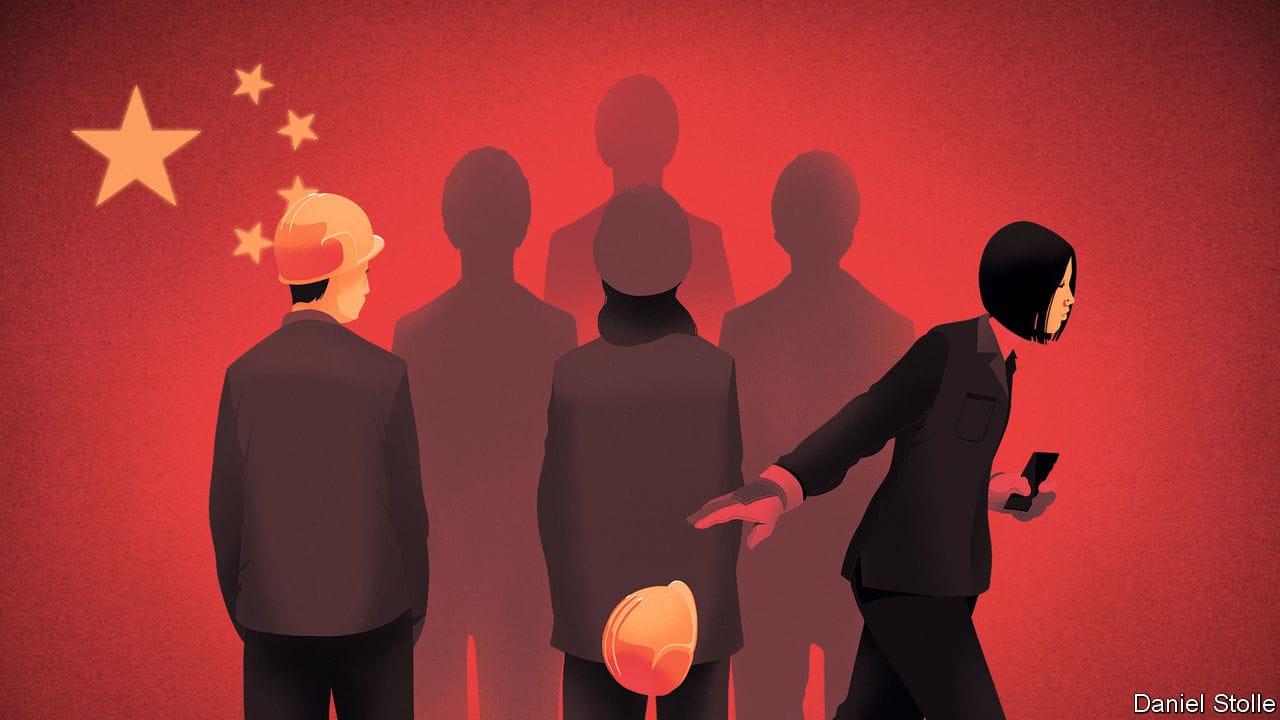
Xi Jinping wants them to focus on the party’s goals. Many cannot see why they should.
习近平希望他们专注于党的目标。许多人不明白为什么他们应该。
Aug 17th 20232023 年 8 月 17 日
音频版播放
The crowd did not seem excited to see George Michael and Andrew Ridgeley. When Wham! became the first Western pop group to perform in Communist China, the audience was instructed to stay in their seats. It was 1985 and, despite appearances, the young people in attendance were in fact joyous. The country around them was by no means free, but it was starting to reform and open up. Over the next three decades the economy would grow at a rapid pace, producing new opportunities. An increasing number of Chinese travelled and studied abroad. Even the Communist Party showed signs of relaxing (a bit). Those brought up during this period had high hopes for the future.
人群似乎对看到乔治·迈克尔和安德鲁·里奇利并不兴奋。当威猛!当成为第一个在共产主义中国演出的西方流行乐队时,观众被要求留在座位上。那是 1985 年,尽管表面上看,参加活动的年轻人实际上很高兴。他们周围的国家绝不是自由的,但它正在开始改革开放。未来三十年,经济将快速增长,创造新的机遇。越来越多的中国人出国旅游、留学。就连共产党也表现出放松的迹象(有点)。这个时期长大的人对未来抱有厚望。
Today, reality is falling short of expectations. A dark cloud hangs over Chinese born in the 1990s and 2000s. Since Xi Jinping won power in 2012, the government has grown more repressive and society less vibrant. Censors have turned the internet into a drearier place, while letting nationalist trolls drum in the state’s talking-points. At university students must grapple with Mr Xi’s forbidding personal ideology. Worst of all for some, China’s economy is stagnating. The unemployment rate for those aged 16 to 24 in cities is over 21%—a number so disheartening that earlier this month the government stopped publishing the data, pending a review.
如今,现实与预期不符。乌云笼罩在90后、2000后的中国人头上。自2012年习近平掌权以来,政府变得更加专制,社会活力减弱。审查机构将互联网变成了一个更加沉闷的地方,同时让民族主义巨魔大肆宣扬国家的谈话要点。在大学生中,学生必须努力应对习近平令人生畏的个人意识形态。对一些人来说最糟糕的是,中国经济停滞不前。城市16岁至24岁人群的失业率超过21%——这个数字如此令人沮丧,以至于政府于本月早些时候停止发布该数据,等待审查。
For our Briefing this week, we talked to young Chinese men and women about how they feel. Plenty still have faith in the party and support Mr Xi’s calls to make China strong. But many are suffering a deep sense of angst. University graduates are finding that the skills they spent years learning are not the ones employers want. Scarce jobs and punishing property prices have dashed their hopes of buying a home and starting a family. We scraped social media and found that the mood is growing darker. Disillusioned youth talk of tangping (lying flat) and bailan (letting it rot), synonyms for giving up.
在本周的简报中,我们与中国年轻男女谈论了他们的感受。许多人仍然对共产党充满信心,并支持习近平让中国强大的呼吁。但许多人正承受着深深的焦虑感。大学毕业生发现,他们花费数年学习的技能并不是雇主想要的。就业机会稀缺和房价下跌让他们买房成家的希望破灭了。我们浏览了社交媒体,发现情绪变得越来越低落。幻灭的年轻人谈论“躺平”和“任其腐烂”,这些都是放弃的同义词。
China is hardly the only country where young people are gloomy. Nearly half of Americans aged 18 to 34 say they lack confidence in the future. When Chinese lie flat, Americans “quiet quit”. Perhaps Gen Z and millennials the world over have a tendency to mope. Yet in China, where some 360m people are between the ages of 16 and 35, something more serious seems to be happening. The ladder to a better life is being lifted away. In response, many are choosing to abandon the rat race and turn inwards. For a country that Mr Xi promises to mould into a great power by mid-century, their ennui raises profound questions.
中国并不是唯一一个年轻人情绪低落的国家。近一半 18 至 34 岁的美国人表示,他们对未来缺乏信心。当中国人平躺时,美国人“悄然退出”。也许世界各地的 Z 世代和千禧一代都有闷闷不乐的倾向。然而在中国,大约有 3.6 亿人年龄在 16 岁至 35 岁之间,更严重的事情似乎正在发生。通往美好生活的阶梯正在被拆除。作为回应,许多人选择放弃激烈的竞争并转向内部。对于一个习近平承诺在本世纪中叶建成强国的国家来说,他们的倦怠提出了深刻的问题。
One is whether their malaise carries political risks. Frustrated young folk jolted China in the past, notably in 1989, when students converged on Tiananmen Square to demand more freedom and less corruption. Last year, fed up with the government’s harsh covid-19 controls, young people gathered in cities across China. Some called for Mr Xi and the party to relinquish power.
一是他们的萎靡是否会带来政治风险。过去,失意的年轻人震动了中国,特别是在 1989 年,当时学生聚集在天安门广场,要求更多自由和减少腐败。去年,由于厌倦了政府对新冠肺炎 (covid-19) 的严厉控制,年轻人聚集在中国各地的城市。一些人呼吁习近平和共产党放弃权力。
Nobody can rule out the possibility of more unrest. But last year’s protests were small and our reporting suggests that China’s young are not bursting with revolutionary fervour. They have grown up with an internet bounded by the great firewall, limiting their access to uncensored news and information. Brought up on propaganda about the party’s accomplishments, many continue to support it wholeheartedly. Even hip young urbanites say the government ought to limit some freedoms.
没有人能够排除发生更多骚乱的可能性。但去年的抗议活动规模较小,我们的报道表明中国的年轻人并没有爆发出革命热情。他们是在被防火墙限制的互联网环境中长大的,这限制了他们获取未经审查的新闻和信息。许多人从小就接受有关党的成就的宣传,并继续全心全意地支持它。即使是时髦的年轻城市居民也表示政府应该限制一些自由。
The real question the party faces is more prosaic: not the threat of revolution, but a quiet rejection of its ambitions. In order to accomplish his goal of restoring China’s greatness, Mr Xi needs the young to get married, have children and reverse the country’s demographic decline. In order to refocus the economy on manufacturing and away from consumer-internet technology, he’d like them to study hard sciences, not dream of designing video games. And he wants more youngsters to work in factories, including the type that might produce weapons for China’s growing armed forces. “Endure hardships” and “eat bitterness”, Mr Xi tells the young. Many cannot see why they should.
该党面临的真正问题更为平淡:不是革命的威胁,而是对其野心的悄悄拒绝。为了实现恢复中国伟大的目标,习近平需要年轻人结婚生子并扭转国家人口下降的趋势。为了使经济重新聚焦于制造业,远离消费互联网技术,他希望他们学习硬科学,而不是梦想设计视频游戏。他希望更多的年轻人在工厂工作,包括可能为中国不断壮大的武装部队生产武器的工厂。习近平告诉年轻人“吃苦”、“吃苦”。许多人不明白为什么他们应该这样做。
The party is mindful of their disenchantment. Policymakers have taken steps to curb speculation in the property market in hope of bringing down prices. Firms have been pressed to treat their overworked young employees better. Under the banner of “common prosperity”, Mr Xi has aimed to increase social mobility and reduce inequality. But much of this has backfired. In going after property developers, tech firms and the tutoring industry, he has harmed new graduates’ most reliable employers.
该党注意到他们的失望情绪。政策制定者已采取措施遏制房地产市场的投机活动,希望降低房价。公司被迫更好地对待过度劳累的年轻员工。在“共同繁荣”的旗帜下,习近平的目标是增加社会流动性并减少不平等。但其中大部分都适得其反。在打击房地产开发商、科技公司和辅导行业的过程中,他伤害了应届毕业生最可靠的雇主。
That leads to the biggest question of all. China’s leaders are fond of contrasting their one-party rule with what they tell their people is a flawed and dysfunctional West, a view stoked but not wholly fabricated by the official media. The unhappiness of young people sets the strengths and weaknesses of each system in clear relief. It is not a comparison that favours China.
这引出了最大的问题。中国领导人喜欢将他们的一党统治与他们告诉人民的有缺陷和功能失调的西方进行对比,这种观点是官方媒体煽动的,但并非完全捏造。年轻人的不幸使每个制度的优点和缺点都清晰可见。这种比较对中国并不有利。
Dropouts in America have alternatives to pursue. The country offers many routes to a fulfilling life. An ambitious few have even been able to harness their dissent to create great art, music or a multi-billion-dollar company. Mr Xi would like young Chinese to find enlightenment in their hardship, too, but not that sort. Advance comes exclusively through the Communist Party. China’s artists are yoked to its message. Having been branded as the party’s rivals, tech entrepreneurs have been humiliated.
在美国,辍学者有其他选择。这个国家提供了许多通往充实生活的途径。少数雄心勃勃的人甚至能够利用他们的异议来创造伟大的艺术、音乐或价值数十亿美元的公司。习近平也希望中国年轻人在苦难中找到启蒙,但不是那样。进步完全是通过共产党来实现的。中国的艺术家被它的信息所束缚。科技企业家被贴上了党的竞争对手的标签,受到了羞辱。
A small but growing number of well-educated, high-potential young Chinese seem likely to abandon their country. Politicians in America and the wider West often say they are on the side of ordinary Chinese. They could prove it by ensuring Western universities and economies welcome young people who feel that their opportunities at home are limited.
少数但数量不断增加的受过良好教育、高潜力的中国年轻人似乎有可能放弃自己的国家。美国和更广泛的西方政客经常说他们站在普通中国人一边。他们可以通过确保西方大学和经济体欢迎那些认为自己在国内机会有限的年轻人来证明这一点。
Let them dream让他们做梦
However, most young Chinese will stay at home. When Mr Xi plays down their individual aspirations in favour of the collective interest, he adds to their gloom. He also ignores the role that dreams and choices in their hundreds of millions played in fuelling China’s four decades of growth. The party needs to offer its disenchanted young new paths to peaceful prosperity. The alternatives, including the stoking of angry, militaristic nationalism, would pose a threat to China and the world. ■
然而,大多数中国年轻人会呆在家里。当习近平淡化他们的个人愿望而支持集体利益时,他会加剧他们的忧郁情绪。他还忽视了数亿人的梦想和选择在推动中国四十年增长中所发挥的作用。该党需要为失望的年轻人提供通往和平繁荣的新道路。其他选择,包括煽动愤怒的军国主义民族主义,将对中国和世界构成威胁。 ■