As the CHIPS Act turns one, semiconductor firms have mixed feelings.
随着 CHIPS 法案通过,半导体公司心情复杂。
Aug 7th 20232023 年 8 月 7 日 经济学人
音频版播放
American chipmakers account for a third of global semiconductor sales. They design the world’s most sophisticated microprocessors, which power smartphones, data centres and, increasingly, artificial-intelligence (ai) models. But neither the American firms nor their Asian contract manufacturers make any such leading-edge chips in America. Given chips’ centrality to modern economies—and, in the age of ai, to war-fighting—that worries policymakers in Washington. Their answer was the chips Act, a $50bn package of subsidies, tax credits and other sweeteners to bring advanced chipmaking back to America, which President Joe Biden signed into law on August 9th 2022.
美国芯片制造商占全球半导体销售额的三分之一。他们设计了世界上最复杂的微处理器,为智能手机、数据中心以及越来越多的人工智能 (ai) 模型提供动力。但美国公司及其亚洲合约制造商都没有在美国生产任何此类尖端芯片。鉴于芯片在现代经济中的核心地位,以及在人工智能时代,在战争中的核心地位,这让华盛顿的政策制定者感到担忧。他们的答案是《芯片法案》,这是一项价值 500 亿美元的一揽子补贴、税收抵免和其他措施,旨在将先进的芯片制造带回美国,总统乔·拜登于 2022 年 8 月 9 日签署成为法律。

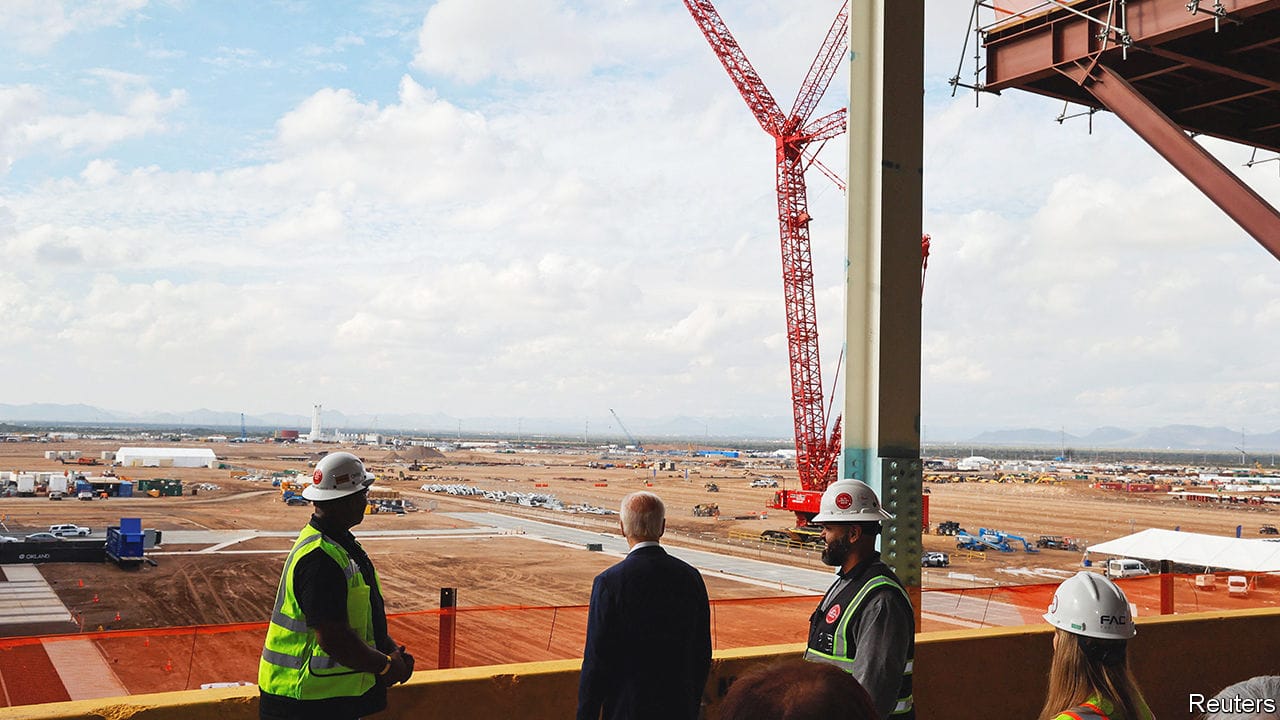
On the surface, the law appears to be having an impact. Since 2020, when it was first floated, chipmakers have announced more than $200bn-worth of investments in America. If all goes to plan, by 2025 American chip factories (fabs, in the lingo) will be churning out 18% of the world’s leading-edge chips (see chart 1). tsmc, a Taiwanese manufacturing behemoth, is splurging $40bn on two fabs in Arizona. Samsung of South Korea is investing $17bn in Texas. Intel, America’s chipmaking champion, will spend $40bn on four fabs in Arizona and Ohio. As the chips Act celebrates its first birthday, and as the administration prepares to start doling out the money, both Democrats and Republicans, who agree on little else these days, regard it as a bipartisan triumph.
从表面上看,该法律似乎正在产生影响。自 2020 年首次上市以来,芯片制造商已宣布在美国投资价值超过 2000 亿美元。如果一切按计划进行,到 2025 年,美国芯片工厂(行话是晶圆厂)将生产出全球 18% 的尖端芯片(见图 1)。台湾制造业巨头台积电正斥资 400 亿美元在亚利桑那州建设两座晶圆厂。韩国三星公司正在德克萨斯州投资 170 亿美元。美国芯片制造冠军英特尔将斥资 400 亿美元在亚利桑那州和俄亥俄州建设四家晶圆厂。在《芯片法案》庆祝一周年之际,随着政府准备开始发放资金,目前在其他问题上几乎没有达成一致的民主党人和共和党人都认为这是两党的胜利。
Any triumphalism may, however, be premature. Leading-edge fabs being built in America are slower to erect, costlier to run and smaller than those in Asia. Complicating matters further, the chipmakers’ American investment binge comes at a time when demand for their wares appears to be cooling, at least in the short term. That could have consequences for the industry’s long-term profitability.
然而,任何必胜论都可能为时过早。与亚洲相比,美国正在建设的领先晶圆厂建设速度较慢,运营成本较高,而且规模较小。让事情变得更加复杂的是,芯片制造商在美国的投资狂潮发生之际,他们的产品需求似乎正在降温,至少在短期内如此。这可能会对该行业的长期盈利能力产生影响。
The Centre for Security and Emerging Technology, a think-tank, estimates that in China and Taiwan companies put up a new plant in about 650 days. In America, manufacturers must navigate a thicket of federal, state and local-government regulations, stretching average construction time to 900 days. Construction, which makes up around half of the capital spending on a new fab, can cost 40% more in America than it does in Asia.
智库安全与新兴技术中心估计,中国大陆和台湾的公司在大约 650 天内建成一座新工厂。在美国,制造商必须遵守一系列联邦、州和地方政府法规,将平均施工时间延长至 900 天。建设成本约占新晶圆厂资本支出的一半,在美国的成本可能比亚洲高出 40%。
Some of that extra cost can be defrayed by the chips Act’s handouts. However, that still leaves annual operating expenses, which are 30% higher in America than in Asia, in part owing to higher wages for American workers. If those workers can be found at all: in July tsmcdelayed the launch of its first fab in Arizona by a year, to 2025, because it could not find enough staff with semiconductor industry experience.
其中一些额外费用可以通过《芯片法案》的发放来支付。然而,这仍然留下年度运营费用,美国的运营费用比亚洲高 30%,部分原因是美国工人的工资更高。如果能找到这些工人的话:今年 7 月,台积电将其在亚利桑那州第一家晶圆厂的投产时间推迟了一年,即 2025 年,因为它找不到足够的具有半导体行业经验的员工。
The planned American projects’ smallish size further undermines the economics. The more chips a fab makes, the lower the unit cost. In Arizona, tsmc plans to make 50,000 wafers a month—equivalent to two “mega-fabs”, as the company calls them. Back home in Taiwan, tsmc operates four “giga-fabs”, each producing at least 100,000 wafers a month (in addition to numerous mega-fabs). Morris Chang, tsmc’s founder, has warned that chips made in America will be more expensive.
计划中的美国项目规模较小,进一步损害了经济效益。晶圆厂生产的芯片越多,单位成本就越低。在亚利桑那州,台积电计划每月生产 50,000 片晶圆,相当于该公司所说的两个“大型晶圆厂”。回到台湾,台积电运营着四家“巨型晶圆厂”,每家每月至少生产 10 万片晶圆(此外还有众多大型晶圆厂)。台积电创始人张忠谋警告称,美国制造的芯片将会更加昂贵。

C.C. Wei, the current chief executive of tsmc, has hinted that the company will absorb these higher costs. He can afford to do this because tsmc will continue to make the lion’s share of its chips more cheaply at home, not in America. The same is true of Samsung, which will spend nearly 90% of its capital budget in South Korea. Even Intel is investing as much in foreign fabs as in American ones (see chart 2). As a result, if all the planned investments materialise, America will produce enough cutting-edge chips to meet only about a third of domestic demand. Apple will keep sourcing high-end processors for its iPhones from Taiwan. So, in all likelihood, will America’s nascent ai-industrial complex.
C.C.台积电现任首席执行官魏伟曾暗示,该公司将消化这些更高的成本。他有能力这样做,因为台积电将继续在国内而不是美国以更便宜的价格生产大部分芯片。三星也是如此,该公司将把近90%的资本预算花在韩国。甚至英特尔对外国晶圆厂的投资也与美国晶圆厂的投资一样多(见图 2)。因此,如果所有计划投资都实现,美国将生产足够的尖端芯片,只能满足约三分之一的国内需求。苹果将继续从台湾为其 iPhone 采购高端处理器。美国新生的人工智能工业综合体很可能也会如此。
The law may have unintended consequences, too. Chip firms that accept state aid are barred from expanding fab capacity in China. This may put firms like tsmc and Samsung, which have plenty of Chinese customers, off investing more in American fabs. It is also leading Chinese chipmakers to invest in producing less fancy semiconductors. The hope is that lots of older-generation chips can do at least some of what fewer fancier ones are capable of.
该法律也可能会产生意想不到的后果。接受国家援助的芯片公司被禁止扩大在中国的晶圆厂产能。这可能会让台积电和三星等拥有大量中国客户的公司放弃对美国晶圆厂的更多投资。它还引领中国芯片制造商投资生产不太精美的半导体。我们希望许多老一代芯片至少能够完成一些更高级芯片无法完成的任务。
According to semi, an industry group, in 2019 China made a fifth of “trailing-edge” chips, which go into everything from washing machines to cars and aircraft. By 2025 it will produce more than a third. In July nxp Semiconductor, a Dutch maker of trailing-edge chips, warned that excess supply from China is putting downward pressure on prices. In the long run, this could hurt high-cost Western producers—or even drive some of them out of business. In July Gina Raimondo, America’s commerce secretary, acknowledged that China’s focus on the trailing edge “is a problem that we need to be thinking about”.
据行业组织 Semi 称,2019 年中国制造了五分之一的“后缘”芯片,这些芯片应用于从洗衣机到汽车和飞机等各种领域。到 2025 年,产量将超过三分之一。荷兰后置芯片制造商恩智浦半导体公司 (nxp Semiconductor) 7 月警告称,中国供应过剩正在给价格带来下行压力。从长远来看,这可能会损害高成本的西方生产商,甚至导致其中一些生产商破产。 7月,美国商务部长吉娜·雷蒙多承认,中国对后缘的关注“是我们需要考虑的问题”。
Hardest to predict is the chips Act’s effect on the semiconductor industry’s notorious boom-and-bust cycle. Usually chipmakers would be boosting capacity at a time of rising demand. Right now the opposite is true. Pandemic-era chip shortages have been replaced by a glut, now that consumers’ insatiable appetite for all things digital seems, after all, to be sated. tsmc’s sales declined by 10% in the second quarter, year on year, and the firm now expects a similar drop for the whole of 2023. Intel’s revenue was down by 15% in the same period. Samsung blamed a chips glut for its falling revenues and profits.
最难预测的是《芯片法案》对半导体行业臭名昭著的繁荣与萧条周期的影响。通常芯片制造商会在需求上升时提高产能。现在情况恰恰相反。大流行时代的芯片短缺已经被供过于求所取代,现在消费者对所有数字事物的贪得无厌的胃口似乎终于得到了满足。台积电第二季度销售额同比下降 10%,该公司目前预计 2023 年全年也会出现类似下降。英特尔同期营收下降 15%。三星将其收入和利润下降归咎于芯片供应过剩。
Chip executives point out that prospects for their industry remain rosy. They are probably right that demand is bound to revive at some point. Yet “inventory adjustments” (reducing oversupply, in plain English) are taking longer than expected. And when inventories finally adjust, the business that emerges may be less lucrative. Since early 2021 Intel, Samsung and tsmc have lost a third of their combined market value, or nearly half a trillion dollars. A few more anniversaries may be needed before the chips Act’s impact on American economic security can be properly evaluated. Investors are already making up their minds. ■
芯片高管指出,他们的行业前景仍然乐观。他们认为需求必然会在某个时候复苏,这一点可能是正确的。然而,“库存调整”(用简单的英语来说,减少供应过剩)所花费的时间比预期的要长。当库存最终调整时,出现的业务利润可能会降低。自 2021 年初以来,英特尔、三星和台积电已经损失了其总市值的三分之一,即近 5000 亿美元。可能还需要几个周年纪念日才能正确评估芯片法案对美国经济安全的影响。投资者已经做出了决定。 ■