**Strains in the country’s CO2-intensive growth model may be an issue for its economy, but good for the planet. **
该国二氧化碳密集型增长模式的压力可能对其经济造成影响,但对地球有利。
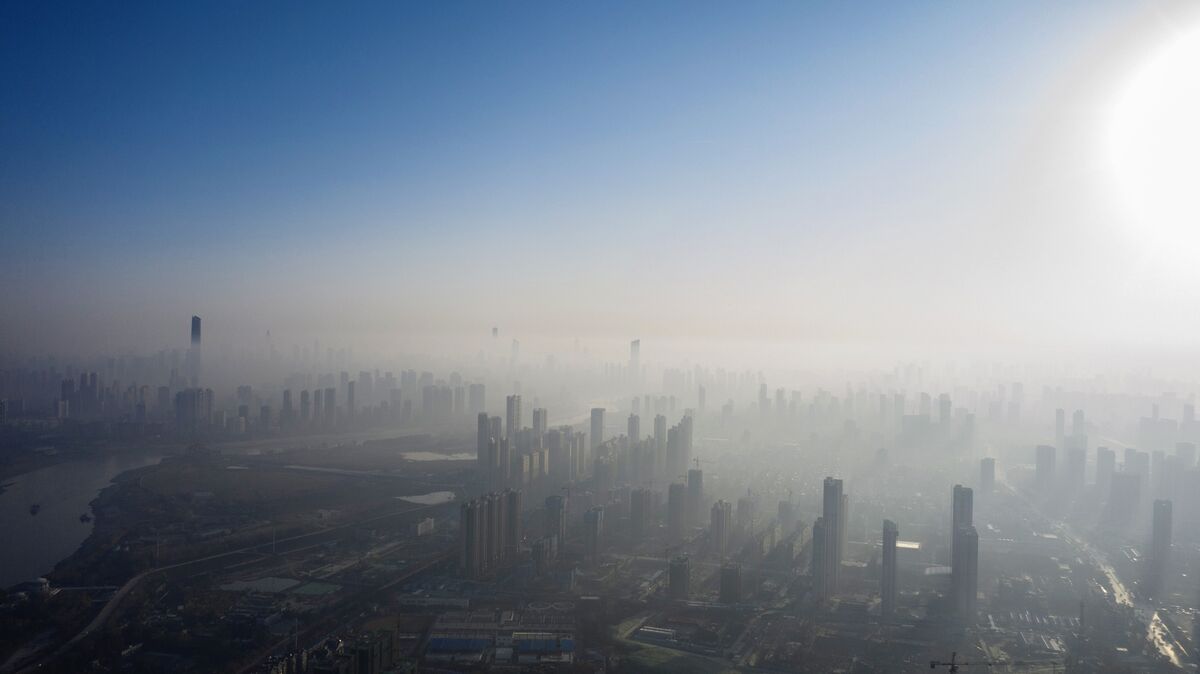
Less pollution?Photographer: Qilai Shen/Bloomberg
减少污染?摄影师:Qilai Shen/彭博社
By David Fickling 大卫·菲克林 2023年8月28日
The story of emissions over the past two decades has been written in Chinese.
过去二十年的排放故事是用中文写成的。
Since it joined the World Trade Organization in 2001 and became the world’s factory, China has contributed nearly two-thirds of the growth in carbon pollution globally. Even in per-capita terms, it’s now a bigger greenhouse emitter than the European Union. The world’s carbon footprint is split into three roughly equal portions: China, all developed nations, and the rest of the world.
自2001年加入世界贸易组织并成为世界工厂以来,中国贡献了全球碳污染增长的近三分之二。即使按人均计算,中国现在的温室气体排放量也超过了欧盟。世界碳足迹大致分为三个部分:中国、所有发达国家和世界其他地区。
The Elephant in the Room
房间里的大象
Nearly two-thirds of the rise in CO2 emissions since 2000 has been in China
2000年以来二氧化碳排放量增长的近三分之二来自中国

Source: Energy Institute 资料来源:能源研究所
Note: Shows change in annual CO2-equivalent emissions relative to 2000.
注:显示相对于 2000 年的年度二氧化碳当量排放量的变化。
That makes the recent signs of strain in the country’s CO2-intensive growth model an issue not just for Beijing, but for the long-term fate of the planet.
这使得中国二氧化碳密集型增长模式最近出现的紧张迹象不仅对北京来说是一个问题,而且对地球的长期命运来说也是一个问题。
If things head in a similar direction to the former communist states of Eastern Europe when their similar economic model came off the rails in 1989, we may be about to see the most dramatic reduction in emissions the world has ever seen. That might be a disaster for China’s leadership, as well as for a population who would likely suffer through a lost decade as the economy reorients toward more productive activities. For China’s long-term prosperity and the fate of the planet, however, it would be an unexpected victory.
如果事情朝着与 1989 年东欧前共产主义国家相似的经济模式脱轨时类似的方向发展,我们可能即将看到世界上有史以来最大幅度的排放量减少。这对中国领导层以及中国民众来说可能是一场灾难,随着经济转向更有生产力的活动,他们可能会经历“失去的十年”。然而,对于中国的长期繁荣和地球的命运来说,这将是一次意想不到的胜利。
Giving up Smoking 戒烟
The 10-year growth rate of carbon emissions was slower in the decade after the fall of communism than in the decade after the first oil crisis
共产主义垮台后十年的碳排放增长率比第一次石油危机后十年要慢

Few people were closely considering the climate implications when the Berlin Wall fell in 1989. But the change was extraordinarily dramatic: In Russia, CO2 output dropped by more than a third over the subsequent decade, and by half in Ukraine and Romania. The 10-year growth rate of global emissions slowed more in the 1990s than it did after the 1973 oil crisis.
1989 年柏林墙倒塌时,很少有人仔细考虑对气候的影响。但变化却异常巨大:在俄罗斯,二氧化碳排放量在随后的十年中下降了三分之一以上,在乌克兰和罗马尼亚则下降了一半。 20 世纪 90 年代全球排放量的 10 年增长率比 1973 年石油危机后放缓得更多。
Through ambitious green policies, the EU managed to cut its greenhouse footprint about 28% between 1990 and 2022. With barely a shred of climate intent, economic crisis has left the oil-stained former Soviet Union about 20% below 1990’s levels.
通过雄心勃勃的绿色政策,欧盟在 1990 年至 2022 年间成功地将温室足迹减少了约 28%。在几乎没有任何气候意图的情况下,经济危机使饱受石油污染的前苏联比 1990 年的水平下降了约 20%。
How was this achieved? The best explanation was outlined in the early 1980s by Hungarian economist János Kornai, who presciently argued that Eastern Europe’s command economies had become bloated under a system of so-called “soft budget constraints.” Investment was being directed not to profitable enterprises that would improve long-term prosperity, but to whatever projects would do most to juice the headline rate of growth. Once the financial bubble burst, swathes of the economy turned out to be junk calories.
这是如何实现的?匈牙利经济学家亚诺什·科尔奈 (János Kornai) 在 20 世纪 80 年代初提出了最好的解释,他有先见之明地认为,东欧的指令性经济在所谓的“软预算约束”体系下变得臃肿。投资不是针对能够改善长期繁荣的盈利企业,而是针对最能提高整体增长率的项目。一旦金融泡沫破灭,经济的大部分内容就会变成垃圾卡路里。
End of the Line 队伍的尽头
The fall of communism in Eastern Europe prompted a collapse in emissions
东欧共产主义的垮台导致排放量锐减

That’s a remarkably apt analogy. Peking University finance professor Michael Pettis, one of the more notable bearish voices on the Chinese economy, is a follower of Kornai, who has argued his theories are a good explanation of the direction the country has taken over the past 15 years.
这是一个非常恰当的比喻。北京大学金融学教授迈克尔·佩蒂斯 (Michael Pettis) 是对中国经济较为著名的悲观声音之一,他是科尔奈的追随者,科尔奈认为他的理论很好地解释了中国过去 15 年的发展方向。
Energy consumption in China is inextricably linked to gross domestic product in a way Kornai would recognize. Former Premier Li Keqiang once argued electricity demand and rail loadings (which are mostly coal) were a better guide to gross domestic product than the official numbers. During the first phase of the Covid-19 pandemic in 2020, Caixin reported that local governments were ordering businesses to keep equipment running in deserted offices to maximize power consumption and minimize the perceived downturn in output.
科尔奈承认,中国的能源消耗与国内生产总值有着千丝万缕的联系。前总理李克强曾表示,电力需求和铁路负荷(主要是煤炭)比官方数据更能反映国内生产总值。据财新报道,在 2020 年 Covid-19 大流行的第一阶段,地方政府命令企业在废弃的办公室中保持设备运行,以最大限度地提高电力消耗并最大限度地减少产出下降。
What would China look like if it spurned the junk calories of energy-intensive growth? The government has been trying to make that switch for a decade. In the early years of Xi Jinping’s presidency, there was much official talk of a switch from investment to consumption as the driver of growth. More recently, the government has pledged to crack down on so-called “dual-high industries” — high in both energy usage, and carbon intensity, such as cement, steel and glass — which account for about half of the country’s greenhouse pollution.
如果中国摒弃能源密集型增长带来的垃圾卡路里,会是什么样子?十年来,政府一直在努力实现这一转变。在习近平担任国家主席的最初几年,官方多次谈论将增长动力从投资转向消费。最近,政府承诺打击所谓的“双高产业”——水泥、钢铁和玻璃等能源消耗和碳强度都很高的产业——这些产业约占中国温室气体污染的一半。
Fuel for You 为您加油
The Xi era has made progress on carbon intensity, but less on energy intensity
习近平时代在碳强度方面取得了进步,但在能源强度方面却进展缓慢

Neither policy has shown many signs of success. Indeed, while the carbon-intensity of Chinese energy consumption has fallen dramatically under Xi’s leadership thanks to rising renewables usage, the energy-intensity of economic growth has stalled relative to his predecessors Hu Jintao and Jiang Zemin.
这两项政策都没有显示出许多成功的迹象。事实上,尽管在习近平的领导下,由于可再生能源使用量的增加,中国能源消费的碳强度大幅下降,但相对于其前任胡锦涛和江泽民而言,经济增长的能源强度却陷入停滞。
That’s likely because the government has become so dependent on energy-intensive heavy industries such as infrastructure and real estate as the only available tool to hit its economic targets. It’s a counterproductive ambition, though: Were China able to generate as many dollars from each megajoule of energy as developed countries, its GDP would be twice as large.
这可能是因为政府已经变得如此依赖基础设施和房地产等能源密集型重工业,将其作为实现其经济目标的唯一可用工具。然而,这是一个适得其反的野心:如果中国能够从每兆焦能源中产生与发达国家一样多的美元,其国内生产总值将是发达国家的两倍。
No one should welcome the prospect of a Soviet-style collapse in China. Quite apart from the domestic human cost, the effects would be a global depression, since China is far more integrated with the world economy than the Soviet Union was in 1989. The ripples of Russia’s hyperinflation are still being felt in 2023, given the role that the chaos of the 1990s had in the rise of Vladimir Putin and his revanchist ideology.
没有人应该欢迎中国出现苏联式崩溃的前景。除了国内人力成本外,其影响还可能是全球萧条,因为中国与世界经济的融合程度远高于 1989 年的苏联。鉴于20 世纪 90 年代的混乱导致了弗拉基米尔·普京 (Vladimir Putin) 及其复仇主义意识形态的崛起。
Bounce Back 反弹
Russia has outperformed comparable economies since its 1990s slump
自 20 世纪 90 年代经济衰退以来,俄罗斯的表现优于同类经济体

And yet Russia’s story is not one of unmitigated misery. When the dust settled on the post-Soviet chaos, it resumed a path of rapid growth that left it, on the eve of the Ukraine war, in a respectable position compared to other complex, oil-exporting large economies.
然而,俄罗斯的故事并不是一个彻头彻尾的苦难。当后苏联的混乱尘埃落定后,它恢复了快速增长的道路,这使得它在乌克兰战争前夕与其他复杂的石油出口大型经济体相比处于令人尊敬的地位。
With an economic transition that avoids the disastrous “shock therapy” policies of Yeltsin-era Russia in favor of bringing state-owned industries more gradually into line with conventional budget constraints, China could reduce its emissions without an economic disaster for its citizens.
通过经济转型,避免叶利钦时代俄罗斯灾难性的“休克疗法”政策,转而让国有工业逐步适应传统的预算限制,中国可以减少排放,而不会给公民带来经济灾难。
Such a shift might even preserve the role of the Communist Party, a key concern for Beijing’s policymakers. A more gentle realignment is more or less what happened in Japan after its own malinvestment bubble popped in 1991 — and that country’s Liberal Democratic Party remains as dominant now as it ever was. With careful management of this crisis, China can save itself and the world — all at the same time.
这种转变甚至可能保留共产党的角色,这是北京决策者关心的一个主要问题。日本在 1991 年不当投资泡沫破灭后,或多或少发生了一次更加温和的重组——而该国的自民党现在仍然像以前一样占据主导地位。通过认真管理这场危机,中国可以同时拯救自己和世界。