But the “Hefei model” will not be easy to emulate
但“合肥模式”并不容易效仿
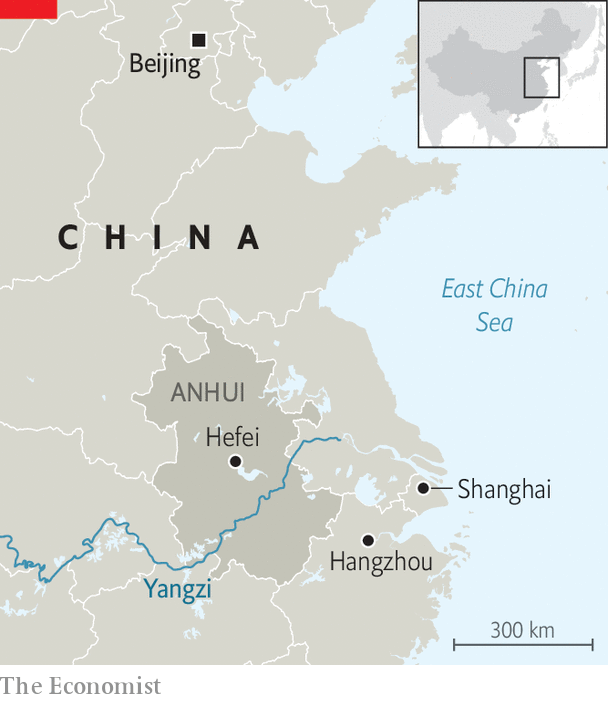
Image: Imago 图片:imago
Aug 5th 2023|HEFEI 合肥|9 min read
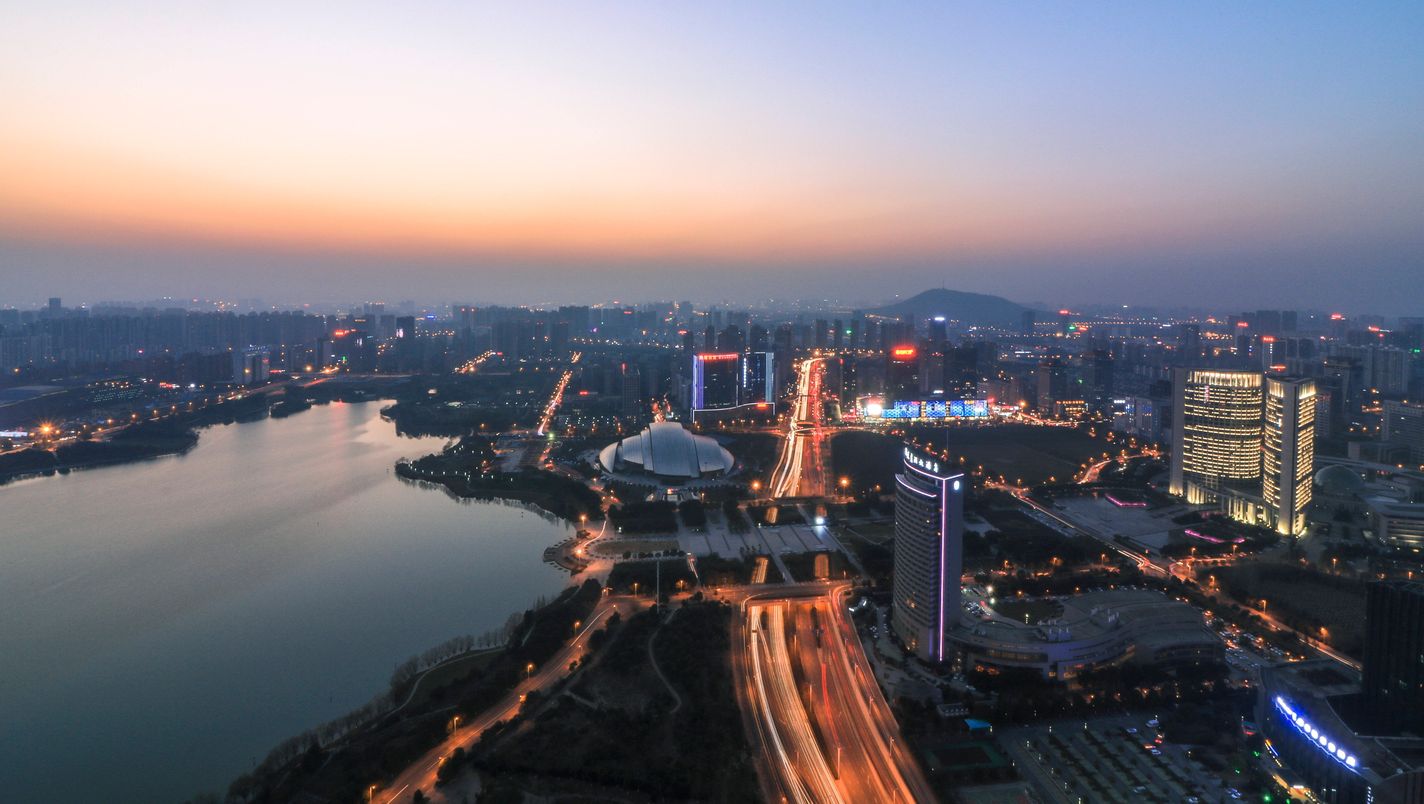
Astroll down “Quantum Boulevard” reveals one of the world’s tightest concentrations of bleeding-edge technology firms. Dozens of companies feed a quantum-computing supply chain that did not exist a few years ago. Their wares include some of the most advanced commercialised technology on the planet. The district is hardly a decade old; not long ago the most modern tech in the area was farming equipment. And it is in an unlikely spot: Hefei, the capital of Anhui, one of China’s less fancied provinces.
漫步“量子大道” , 你会发现这里汇聚了全球最密集的尖端科技公司之一。数十家公司为几年前还不存在的量子计算供应链提供着支持。它们的产品涵盖了全球最先进的商业化技术。这个区域成立还不到十年;不久前,这里最先进的科技还只是农业设备。而且,它位于一个意想不到的地方:合肥,中国不太受青睐的省份之一——安徽省的省会。
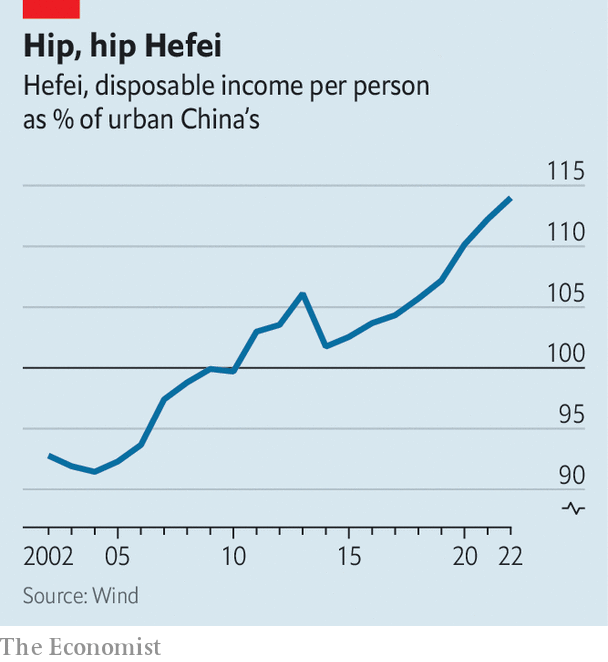
China’s growth is flagging, but its economic miracle appears alive and well in Hefei. Home to about 9.6m people, the inland city saw its GDP grow by more than 8% a year on average from 2012 to 2022. Once considered backward and poor, Hefei’s residents now enjoy a disposable income that comfortably exceeds China’s urban average (see chart).
中国经济增长放缓,但其经济奇迹在合肥似乎依然鲜活。这座内陆城市拥有约 960 万人口,2012 年至 2022 年期间,其 GDP 年均增长率超过 8%。合肥曾被认为是落后贫困的城市,如今居民的可支配收入远超中国城镇平均水平(见图表)。
The city’s success owes much to what some call the “Hefei model”. A unique combination of local-government investment and private enterprise, the model has been described as state capitalism at its best. It has fostered industries like high-end manufacturing, electric vehicles (EVs), biotech and semiconductors. These so-called strategic, emerging industries now account for over 56% of Hefei’s industrial output, compared with less than 27% in 2013. Whatever local officials have been doing, it appears to be “the right mix of industrial policy and private-sector mojo,” says Robin Xing, an economist at Morgan Stanley and a Hefei local.
合肥的成功很大程度上归功于一些人所称的“合肥模式”。这种模式将地方政府投资与私营企业独特地结合在一起,被誉为国家资本主义的典范。它培育了高端制造业、电动汽车、生物技术和半导体等产业。这些所谓的战略性新兴产业目前占合肥工业总产值的 56%以上,而 2013 年这一比例还不到 27%。摩根士丹利经济学家、合肥本地人 Robin Xing 表示,无论地方官员采取了何种措施,这似乎都是“产业政策与私营企业活力的完美结合”。
This style of growth is precisely how Xi Jinping, China’s leader, envisions the country’s future. Hefei’s technological progress chimes with Mr Xi’s call for an “Industrial Revolution 4.0”, in which China shakes off “low-quality” growth—cheap manufacturing and debt-financed homebuilding—by capturing entirely new industries and their supply chains. This vision reserves special attention for the inland backwaters that have missed out on much of the internet boom in coastal provinces. If Mr Xi has his way, the next decade of development will look more like Hefei than today’s tech hubs of Shenzhen and Hangzhou.
这种增长模式正是中国领导人习近平对国家未来的设想。合肥的科技进步与习近平提出的“工业革命4.0”理念不谋而合。在工业革命4.0中,中国将通过抓住全新产业及其供应链,摆脱“低质量”增长模式——廉价制造业和债务融资型住宅建设。这一愿景特别关注那些错过了沿海省份互联网繁荣的内陆落后地区。如果习近平如愿以偿,未来十年的发展将更像合肥,而不是如今的深圳和杭州等科技中心。
BOE Technology, the world leader in LCD displays, has some of its main factories in Hefei. So does NIO, one of the world’s fastest-growing ev companies. China’s leader in voice-recognition artificial intelligence, iFlyTek, was founded by the local university. Its most advanced DRAM chipmaker, CXTM, was co-founded by the local government.
全球领先的液晶显示器制造商京东方科技,其部分主要工厂位于合肥。全球增长最快的电动汽车公司之一蔚来汽车也位于合肥。中国语音识别人工智能领域的领军企业科大讯飞是由当地大学创立的。其最先进的 DRAM 芯片制造商 CXTM 是由当地政府联合创立的。
Foreign companies have also endorsed Hefei’s efficiency. Volkswagen, a German carmaker, has operated manufacturing plants in the city for years. Earlier this year it announced plans for a €1bn ($1.1bn) innovation centre in Hefei that will help design evs. Such hubs are rare outside China’s largest coastal cities, especially for multinationals. Few inland areas can muster the talent, logistics and supply chains to foster them. But Hefei has the right conditions to set up such a facility, says Ralf Brandstätter, Volkswagen’s China chief.
外国公司也对合肥的效率表示认可。德国汽车制造商大众汽车多年来一直在合肥运营制造工厂。今年早些时候,大众宣布计划在合肥建立一个投资 10 亿欧元(11 亿美元)的创新中心,以协助设计电动汽车 。这样的中心在中国沿海大城市以外并不多见,尤其对跨国公司而言。很少有内陆地区能够汇聚足够的人才、物流和供应链来培育这些中心。但大众汽车中国区总裁拉尔夫·布兰德施泰特表示,合肥拥有建立此类中心的合适条件。
Boulevard of unbroken dreams
不灭梦想的大道
Hefei’s success has stirred plenty of curiosity. Delegation after delegation of officials from less prosperous regions have visited the city in the hopes of taking some economic magic back home. A staff member at a state investment group in Hefei says his firm is booked to capacity over the next month hosting visitors from other city governments.
合肥的成功引发了人们的好奇。来自欠发达地区的官员代表团纷纷访问合肥,希望将一些经济魔力带回国内。合肥一家国有投资集团的一名员工表示,下个月其他市政府官员的来访已经预订满。
They will quickly learn the model’s essential ingredients. The first is a large pool of highly educated, motivated people. Hefei is far enough inland—about 470km from Shanghai—to have missed out on the 1990s boom in the Yangzi river delta. But it is close enough to absorb the influence of its better-off neighbours, giving it what Anhui locals say is a scrappy, underdog attitude.
他们很快就会学会这种模式的精髓。首先,就是拥有大量受过高等教育、积极进取的人才。合肥地处内陆,距离上海约470公里,错过了上世纪90年代长江三角洲的繁荣。但它又足够靠近周边较富裕的地区,能够吸收这些地区的影响力,这赋予了它一种安徽当地人所说的“斗志昂扬、弱者心态”。
During the Cultural Revolution, a politically tumultuous period between 1966 and 1976, the University of Science and Technology of China (USTC) was forced to leave Beijing. The nation’s top tech college tried several cities before settling in Hefei in 1970. In the flight from political violence, often directed at academics, it lost more than half its scholars and equipment.
1966 年至 1976 年,即文化大革命期间,政治动荡时期,中国科学技术大学(USTC)被迫撤离北京。这所全国顶尖的理工院校在 1970 年最终落户合肥之前,曾尝试过多个城市。在逃离政治暴力的过程中,这些暴力往往针对学术界,USTC 失去了超过一半的学者和设备。
But utsc has now re-emerged as a global centre for science. The surrounding education system has also flourished, giving the city a high density of good schools, notes Christopher Marquis, the co-author of “Mao and Markets: The Communist Roots of Chinese Enterprise”.
但如今, 多大山大已重新崛起,成为全球科学中心。周边的教育体系也蓬勃发展,使得这座城市拥有大量优质学校,《毛泽东与市场:中国企业的共产主义根源》一书的合著者克里斯托弗·马奎斯指出。
That has made it a hub for advanced technology. USTC has designed China’s most advanced quantum computer. Not far away at the Institute of Physics, scientists are testing one of the world’s most advanced fusion-energy reactors, the Experimental Advanced Superconducting Tokamak. The earliest human trials with CRISPR, a genetic-engineering tool, were conducted at a Hefei hospital in 2015. Since then a thriving biosciences industry has sprung up.
这使得合肥成为了先进技术的中心。中国科学技术大学设计了中国最先进的量子计算机。在不远处的中科院物理研究所,科学家们正在测试世界上最先进的聚变能反应堆之一——实验先进超导托卡马克装置。最早的基因工程工具 CRISPR 人体试验于 2015 年在合肥一家医院进行。自此,蓬勃发展的生物科学产业如雨后春笋般涌现。
A second ingredient of the Hefei model is the flow of talent. The city government frequently recruits from the engineering and science departments of local universities. It also encourages exchanges between government offices, university departments and companies, building trust and networks. One local cadre spent years at USTC helping researchers identify marketable patents, while holding a government position. Businesspeople in Hefei say officials throughout the local administration can discuss industry topics in depth.
合肥模式的第二个要素是人才流动。市政府经常从当地大学的工程和科学系招聘人才。市政府还鼓励政府部门、大学院系和企业之间的交流,建立信任和人脉网络。一位当地干部曾在中国科技大学工作多年,在担任政府职务的同时,还帮助研究人员寻找有市场价值的专利。合肥商界人士表示,当地各级政府官员可以深入探讨行业话题。
A third factor is the “chain boss” system. The government has created groups of firms in 12 industries, including semiconductors, EVs, quantum sciences and biotechnology. Each group has a “chain boss”: a government official who oversees big-picture planning for the industry. In 2020, for example, Hefei’s Communist Party chief was the chain boss of the city’s integrated-circuits industry. The mayor oversaw the display-screen industry.
第三个因素是“产业链总负责人”制度。政府在12个行业设立了企业集团,包括半导体、电动汽车、量子科学和生物技术。每个产业集团都有一位“产业链总负责人”:一位负责监督该行业总体规划的政府官员。例如,2020年,合肥市委书记是该市集成电路产业的产业链总负责人。市长则负责显示屏产业。
These bosses work with a state-appointed “chain leader”, typically the dominant company within an industry. The government passes policy directions to this leader, which shares them with other companies in the supply chain. Companies and officials use this communication channel to discuss the allocation of state capital, the sourcing of materials and potential bottlenecks in supplies, noted Ni Hua, an analyst at East Asia Qianhai Securities, in a report last year.
这些老板与国家任命的“产业链领导者”合作,后者通常是行业内的主导企业。政府将政策方向传达给这位领导者,后者再将政策方向分享给供应链中的其他公司。东亚前海证券分析师倪华在去年的一份报告中指出,企业和官员利用这一沟通渠道讨论国有资本的配置、材料采购以及潜在的供应瓶颈。
Before the state invests in a new company, officials consult with all members of a chain to understand how the newcomer will fit in, says an executive at a local quantum-computing firm. One young entrepreneur who recently started a business in Hefei says that breaking into these industry groups is incredibly difficult. There is little scope for ruthless competition within supply chains. Instead the focus is on beating companies in other regions or countries.
当地一家量子计算公司的高管表示,在国家投资一家新公司之前,官员们会与产业链上的所有成员进行磋商,以了解新公司将如何融入其中。一位最近在合肥创业的年轻企业家表示,打入这些行业集团极其困难。供应链内部几乎没有残酷竞争的空间。人们的重点是击败其他地区或国家的公司。
The fourth ingredient in the model is state capital. While cities elsewhere in the world fund schools, build sewers or house the poor, Hefei’s administration ploughs money into the most promising companies it can identify. It has been described as a “government of investment bankers”. Its outlays flow mainly through three vehicles. Each has sprawling portfolios spanning hundreds of investments.
该模式的第四个要素是国有资本。世界其他城市都在资助学校、修建下水道或为穷人提供住房,而合肥市政府却把资金投入到它能找到的最有前景的公司。它被描述为“投资银行家政府”。其支出主要通过三个投资工具进行。每个投资工具都拥有庞大的投资组合,涵盖数百项投资。
Chained melody 连环旋律
These investments give the city government broad reach. Companies such as BOE, the display-maker, and NIO, the ev firm, stand at the centre of vast supply chains. Smaller companies move to Hefei to be closer to them. Most remain privately owned. But if they suit the government’s plan for the supply chain, they will probably attract some state investment. In this way entire supply chains are linked up by just a few state investors that answer to the city government.
这些投资赋予了市政府广泛的影响力。诸如显示器制造商京东方和电动汽车制造商蔚来等公司,都处于庞大供应链的中心。一些规模较小的公司迁往合肥,以便更靠近这些公司。大多数公司仍然是私营企业。但如果它们符合政府的供应链规划,可能会吸引一些政府投资。这样一来,整条供应链就由少数几家对市政府负责的国有投资者连接起来。
For nearly a decade cities and provinces across China have been experimenting with state-backed venture capital, raising as much as $1trn. But many of their investments have yielded mediocre returns at best. China’s venture-capital state has been written off as a cash sink and a prime opportunity for corruption. Last year, for example, anti-corruption authorities rounded up executives at China’s premier state fund, the National Integrated Circuit Fund, in an attempt to weed out graft.
近十年来,中国各省市一直在尝试政府支持的风险投资,筹集的资金高达1万亿美元。但其中许多投资的回报充其量也只是平庸之作。中国的风险投资机构一直被视为资金的“黑洞”,也是滋生腐败的温床。例如,去年,反腐部门围捕了中国首屈一指的国家基金——国家集成电路产业基金的高管,以期铲除腐败。
What sets Hefei apart? The city’s state capitalists have clearly benefited from the city’s history and location. Not every inland metropolis can learn from Shanghai without being swamped by it, or provide refuge to a great university. The tight links of the “chain boss” system also ensure that Hefei’s state capitalists do not invest without guidance from industry.
合肥的独特之处何在?这座城市的国有资本家显然受益于其历史和地理位置。并非所有内陆大都市都能学习上海而不被其淹没,或为一所优秀的大学提供庇护。“产业链老板”体系的紧密联系也确保了合肥的国有资本家不会在没有产业指导的情况下进行投资。
Hefei’s state investors have also been unusually adventurous. Most cities lack the expertise to run private-equity funds. And they do not have incentives to make bets with distant, uncertain pay-offs. Cadres often spend just five years in one location. Even if a long-term investment were to succeed, they would not be around to enjoy their triumph. These short horizons inhibit officials’ investment choices. Many government funds, for example, have put money into chip designers not chipmakers, notes Tilly Zhang, an analyst at Gavekal Dragonomics, a research house. Chip design is less capital-intensive and quicker to show returns.
合肥的国有投资者也异常大胆。大多数城市缺乏运营私募股权基金的专业知识。而且,他们也没有动力去押注回报长远且不确定的项目。干部通常只在一个地方待五年。即使长期投资成功,他们也无法在世上享受胜利的果实。这种短视限制了官员的投资选择。例如,研究机构龙洲经讯的分析师张蒂莉指出,许多政府基金将资金投给了芯片设计公司,而不是芯片制造商。芯片设计的资本密集程度较低,而且回报更快。
Hefei’s state capitalists have no such inhibition. The local government’s first big punt was a $5.2bn investment in BOE in 2008. (Officials delayed the construction of a subway system in order to scrape the funds together.) The LCD screen industry was then dominated by South Korea and Japan. Critics noted that it would take years to for Chinese firms to be able to compete. But BOE eventually built several plants in Hefei and has since come to dominate the global industry.
合肥的国有资本家没有这样的顾虑。当地政府的第一笔大手笔投资是2008年对京东方的52亿美元投资。(为了筹集资金,官员们推迟了地铁系统的建设。)当时,液晶显示屏行业由韩国和日本主导。批评人士指出,中国企业需要数年时间才能与之竞争。但京东方最终在合肥建了几家工厂,并从此在全球行业占据主导地位。
NIO, the electric-car maker, was even riskier. In 2020 the group was on the verge of collapse when Hefei invested 5bn yuan ($700m). nio then moved its China headquarters and some production facilities to the city. In less than two years NIO had recovered and its share price soared. The city made a return of up to 5.5 times its initial investment, according to Bloomberg. Hefei Jiantou, a government fund that invested in both BOE and NIO, has taken in investment income of at least 5bn yuan each year between 2019 and 2021.
电动汽车制造商蔚来的风险更大。2020 年,该集团濒临倒闭,当时合肥投资了 50 亿元人民币(合 7 亿美元)。 蔚来随后将其中国总部和部分生产设施迁至合肥。不到两年,蔚来就恢复元气,股价飙升。据彭博社报道,合肥的回报高达其初始投资的 5.5 倍。合肥建投是一家同时投资京东方和蔚来的政府基金,在 2019 年至 2021 年期间,每年的投资收益至少达到 50 亿元人民币。
For Mr Xi’s economic vision to succeed, the Hefei model will have to spread far beyond its place of origin. Smaller cities will have to sprout big firms in leading industries, such as EVs, solar energy and chips. One quantum boulevard will not be enough.
习近平的经济愿景若要成功,合肥模式必须推广到其发源地之外。较小的城市必须涌现出电动汽车、太阳能和芯片等领先行业的大企业。一条量子大道是不够的。
But experimentation in one city has often provided a template for the rest of the country. The “Shenzhen model” in the 1980s, for example, pioneered the combination of Chinese labour and foreign capital that turned southern China into the workshop of the world. Around the same time the “Wenzhou model”, named after the south-eastern port city, showed that household factories, often financed by family savings, could succeed, with the help of peripatetic sales agents travelling up and down the country.
但一个城市的试验往往能为全国其他地区提供模板。例如,20世纪80年代的“深圳模式”率先将中国劳动力与外国资本结合起来,将中国南方变成了世界工厂。大约在同一时期,以这座东南港口城市命名的“温州模式”表明,家庭工厂(通常由家庭储蓄提供资金)在全国各地奔波的销售代理的帮助下也能取得成功。
Can the Hefei model also be exported? Several inland cities have similar starting conditions, such as good schools and strong industrial bases. Such places might be able to replicate some of Hefei’s investment strategies, says Mr Xing.
合肥模式也能推广吗?一些内陆城市也拥有类似的起步条件,例如优质的教育和强大的工业基础。这些地方或许可以复制合肥的一些投资策略,邢先生说道。
But Hefei’s success suggests that education, industry and geography are not enough. Political incentives must also align. Mr Xi frequently demands loyalty and austerity from his cadres. The Hefei model, on the other hand, requires gumption and daring. State capitalists must be prepared to take the kind of risky bets that do not always pay off. The model cannot succeed in other cities unless their local cadres are free to fail. ■
但合肥的成功表明,仅有教育、产业和地理位置是不够的。政治激励也必须协调一致。习近平经常要求干部忠诚、厉行节约。另一方面,合肥模式需要勇气和胆识。国有资本家必须准备好承担那些并非总能带来回报的高风险赌注。除非当地干部能够自由地承担失败的风险,否则这种模式在其他城市是无法成功的。 ■
For more expert analysis of the biggest stories in economics, finance and markets, sign up to Money Talks, our weekly subscriber-only newsletter.
欲了解更多专家对经济、金融和市场领域重大新闻的分析,请订阅我们每周仅向订阅者提供的新闻通讯 《Money Talks》 。 。*